Basel III: An Overview of the safer ‘safety net’

by Francois van Dyk
Senior Lecturer - Department of Finance, Risk Management and Banking
University of South Africa
 THE ROAD TO BASEL III: THE FINANCIAL CRISIS
 he search for the recent financial crisis culprits started out with finger-pointing towards greedy profiteers among lenders and investment bankers, although this finger-pointing game soon became politicised as U.S. deregulation in the Bush administration was being blamed by Democrats while Republicans pointed to influential Democrats Fannie Mae and Freddie Mac and their helpers in the US Congress.
Whether the banking sector is to blame for the financial turmoil is another question - with a dramatic number of causes and relevant second round effects continuously being put on the table by economists and financial experts globally – this debate will, however, be reserved for another day.
When the finger-pointing games became a thing of the past and the dust of the recent financial crisis mostly settled, many market participants as well as economic and political leaders made no secret of the fact that financial or banking regulation should be relooked and improved and or intensified. Not only are these opinions regarding regulation directed at the banking sector, but also at the shadow banking system.
The 2008 Nobel Prize in Economics recipient, Paul Krugman for example was one who pointed at the shadow banking sector and stated that institutions that “act like banks” should be regulated similarly to banks(1).
Within the demand for the review and tightening of banking or financial sector regulation, ‘bank capital’ arguably prevailed as the area or topic most in need of attention. Alan Greenspan was of the opinion that banks should have a stronger capital cushion accommodating improved regulatory capital requirements(2), and Eric Dinallo was quoted saying that any financial institution should ensure that it has the necessary capital to support its financial commitments(3).
In response to these and the other comments and proposals from economists, bankers and financial experts, the Basel Committee on Banking Supervision (BCBS) set forth to update their guidelines for capital and banking regulations in order to ensure that the financial system cannot suffer the same type of collapse and resultant economic slowdown that occurred in 2007 to 2009.
In December 2009, the Basel Committee on Banking Supervision (BCBS) issued a package of proposals to the public for review and comment, in the form of two consultative documents, namely:
- Strengthening the resilience of the banking sector(4), and
- International framework for liquidity risk measurement, standards and monitoring(5)
After receiving over 200 consultative review comments the oversight body (Group of Central Banker Governors and Heads of Supervision) of the Basel Committee on 12 September 2010 announced that it endorsed the capital and liquidity reform package, otherwise known as Basel III, which was first proposed in December 2009 and amended in July 2010.
In November 2010 the G20 (at the Seoul Summit) also endorsed the new ‘Basel III’ capital and liquidity requirements as well as the Financial Stability Board’s (FSB) policy framework for reducing the moral hazard of systemically important financial institutions. The G20 also put its weight behind the very long transitional periods for full implementation of the Basel III proposals.
“The new standards will markedly reduce banks’ incentive to take excessive risks, lower the likelihood and severity of future crises, and enable banks to withstand – without extraordinary government support – stresses of a magnitude associated with the recent financial crisis.”(7)
Although there are a number of areas and details needing further development and while global debate will inevitably continue, the core principles of Basel III are set.
THE NEED FOR BASEL III (SHORTCOMINGS OF BASEL II)
Just as in many other area of life, Basel II received its fair share of possible shortcomings from a wide spectrum of sources.One of these shortcomings or faults is that banks were (or are currently) allowed to use their own risk models to set minimum capital levels. This, in essence, allows banks to tell the regulators how much equity they need to hold. This “role reversal” might have come about not only by the Basel II framework, but by central banks not having the expertise in this area, thus placing the regulators in a position from where it is difficult to judge (whether more sophisticated approaches are more effective).
Another well-stated case, was that some of these internal risk models used by banks contains flaws or weaknesses while these models perform poorly and greatly under-estimate risk exposure, resulting in banks to reassess and reprice credit risk. To some extent, this reflects the difficulties in estimating and accounting for high-frequency, low-probability events.
The list of opinions on the shortcomings and faults of Basel II goes on, and while a list of the same nature is growing for Basel III one fact must surely be true – improvements to Basel II are required and necessary. The question is whether Basel III is heading in the right direction?
AIM and TARGET OF BASEL III
Basel III is not a brand new framework – it merely builds on the International Convergence of Capital Measurement and Capital Standards document (Basel II), thus Basel III is Basel II plus the lessons learned from the financial crisis.
In short, Basel III can be explained as ”a comprehensive set of reform measures, developed by the BCBS, to strengthen the regulation, supervision and risk management of the banking sector.”(8)
These risk and regulatory reform measures, as mentioned above, aim to(9):
- Improve the banking sector’s ability to absorb shocks arising from financial and economic stress, whatever the source.
- Improve risk management and transparency.
- Strengthen banks’ transparency and disclosures.
The target of the risk and regulatory reform (Basel III) is(10):
- Bank-level, or microprudential, regulation – which will help raise the resilience of individual banking institutions in periods of stress.
- Macroprudential – system wide risks that can build up across the banking sector as well as the procyclical strengthening of these risks over time.
Thus, given the target as laid out by the BCBS, Basel III can be broken down into three key parts(11):

Basel III in short encompasses the following, which will be detailed in the subsequent section:
- A new unweighted leverage ratio;
- Two new capital buffers (conservation buffer and a counter-cyclical buffer);
- New and substantial capital charges (for non-cleared derivative and other financial market transactions); and
- Significant revisions to the rules on the types of instrument that is regarded as bank capital.
THE BASEL III NUMBERS
The detail pertaining to each of these new or amended elements is presented below, in numbered subsections.
1. Bank Capital: Revised (Minimum) Capital Ratios (and deductions)
This entails a tighter definition of common equity as well as an increase in the core Tier 1 capital requirement. This is to raise the quality, consistency and transparency of the capital base.
- Core Tier 1 (common equity)
Currently Basel II requires that a bank holds 2% of Core Tier 1 capital (to risk weighted assets) with Core Tier 1 consisting of ordinary shares, retained earnings and profits. Basel III contains a tougher categorisation or definition of “common equity” – essentially common shares plus retained earnings with a requirement to hold 4,5% of common equity.
- Total Tier 1
Increases from the current 4% under Basel II to 6% under Basel III, which translates to the fact that other types of Tier 1 instruments (“additional going concern capital”), can account for up to 1,5% of Tier 1 capital.
- Total capital
The total minimum capital requirement remains at 8% (subject to the new capital buffer). As 6% of capital must be Tier 1 capital, it means that Tier 2 capital (which will no longer be divided into upper and lower Tier 2) can only account for 2% of capital. Tier 3, which is currently solely used for market risk purposes under Basel II, is completely removed.
- Deductions from capital
Under Basel III, deductions from capital must generally be made from common equity Tier 1. This is tougher than under Basel II, where a number of deductions are made from total capital.
Note that the July 2010 Basel III amendments did relax some of the proposed deductions, now allowing partial inclusion (rather than deduction as proposed in December 2009) of minority interests, certain deferred tax assets and mortgage servicing rights.
2. New Capital Buffers
Capital conservation buffer
Under Basel III all banks will be required to hold sufficient capital to meet the minimum capital ratios (as detailed above), while also having a “capital conservation buffer” above the minimum 8% total capital. This capital conservation buffer is set at 2,5% (of risk-weighted assets) and must be made up solely of common equity, after deductions. Thus, effectively common equity capital must be equal to minimum 7% of risk-weighted assets other than in times of stress when the buffer can be drawn down. Should the capital levels fall within the buffer will force banks to conserve (rather than distribute) earnings, which will place limits the ability of banks to, for example pay dividends.Compared to the current Basel II regulatory framework, which prescribes a 2% Core Tier 1 requirement, this boils down to more than a threefold increase (in the Core Tier 1 requirement).
Purpose: The purpose of this buffer is to ensure that banks can maintain capital levels throughout a significant downturn and that banks have less discretion to deplete their capital buffers through, for example dividend payments. This buffer will thus ensure that banks maintain a buffer that can be used to absorb losses during periods of stress, while banks will be allowed to draw on the buffer during stressful periods.
Implementation: The conservation buffer will become fully effective on 1 January 2019, as such the buffer will be phased in between 1 January 2016 and the end of 2018. The buffer will begin at 0,625% of risk-weighted assets on 1 January 2016 and increase each subsequent year by an additional 0,625 percentage points until 1 January 2019 when the buffer will reach its final level of 2,5% of risk-weighted assets.
Mechanics: The table below summarises the mechanics of the buffer, with an increasing percentage of earnings subject to the conservation requirement as common equity of a bank approaches the Basel III minimum.
Minimum Capital Conservation Standards |
|
Common Equity Ratio |
Minimum Capital Conservation Ratio (as % of earnings) |
4.5% - 5.125% |
100% |
2.125% - 5.75% |
80% |
5.75% - 6.375% |
60% |
6.375% - 7.0% |
40% |
> 7.0% |
9% |
Source(12)
Counter-cyclical buffer
At certain times banks may be required to hold a counter-cyclical buffer of up to 2,5%, (within a range of 0% - 2,5%) of capital, in the form of common equity or other fully loss absorbing capital. This counter-cyclical buffer will, however, only apply at the discretion of the national regulators.Purpose: This buffer is in essence a macro-prudential tool to protect the banking sector from periods of excessive credit growth, that results in a system-wide build up of risk.
Implementation: This counter-cyclical buffer will be phased in from January 2016 with January 2019 set as the planned date for the buffer to become fully effective.
The accelerated build up of the capital conservation buffer and the counter-cyclical buffer is recommended for countries that experience excessive credit growth.
3. New Unweighted Leverage Ratio
US banks have been subject to a leverage ratio for some time, but this tool has never formed part of the Basel regulatory framework. The BCBS has now agreed to test an unweighted ratio of 3% over a transition period running from 1 January 2013 to 2017. The committee will track the ratio, its component factors and impact over this period and will require bank-level disclosure of the ratio and its factors from January 2015. Final adjustments (based on the results of the ‘test’ run) to the ratio will be carried out in the first half of 2017 where after the ratio will be fully effective from 1 January 2018, based on appropriate calibration and review.
The key regarding this new unweighted leverage ratio is its heavy dependency on the accounting standards or rules used, for instance GAAP or IFRS. The use of a particular accounting rule or standard set would influence the extent to which netting would be permitted in the calculation of the ratio – this of course before or without any netting or other restrictions being applied by the local regulator. In most cases to date, countries that have applied general leverage ratios have allowed for netting according to local GAAP principles.
4. New Liquidity & Funding Requirement(13)
The BCBS is introducing a global minimum liquidity standard for international active banks by way of a 30-day liquidity coverage ratio (LCR) requirement supported by a longer-term structural liquidity ratio[net stable funding ratio (NSFR)].
Purpose: The purpose of the LCR is to ensure a bank can manage a short-term liquidity crisis, while the NSFR’s aim is to reduce the refinancing risks on the balance sheet of a bank.
Implementation: The LCR will take effect in January 2015 after an observation period beginning in 2011, while the NSFR will apply as a minimum standard from January 2018.

(14)LCR Definition included in endnote 13

(15)NSFR Definition included in endnote 14
In essence, the principles of the proposed ratios are not surprising while the ratios’ fundamental logic is commonly used in many banks’ internal models to manage liquidity. It must be noted that compared to typical generic ratios that are common in banks’ treasury models, the NSFR involves a much greater level of liquidity than what most banks today consider a funding position that can be described as a ‘common sense position’. This significant change might influence or even force banks to restructure their liquidity portfolio, or part thereof.
5. Increased capital requirements for certain instruments
A number of provisions were part of the December 2009 proposal, that would have seen a dramatic increase in the capital requirements for counterparty credit risk (CCR) exposures arising from banks’ (non-cleared) repos, securities and derivatives financing operations. These proposals were significantly revised in July 2010, but were not mentioned in the September 2010 press release.
After some amendments the Basel III package it is now set to include some major modifications compared to the Basel II counterparty credit risk (CCR) framework, including increased capital requirements for CCR exposures. The final and latest report regarding the CCR framework includes the following:
- Credit Valuation Adjustment (CVA)
This is a new capital charge to cover the risk of mark-to-market losses associated with a weakening in the creditworthiness of a derivative counterparty. - Asset Value Correlation (AVC)
A 25% asset value correlation (AVC) adjustment, which is a multiplier applied when risk-weighting exposures to large institutions. This adjustment will only apply to exposures to regulated financial institutions with assets greater than $100 billion, as well as unregulated financial institutions of any size. - Measures to reduce over-reliance on external credit ratings in assessing CCR
Some new measures are introduced which aim to reduce the over-reliance on external credit ratings in assessing counterparty credit risk (CCR). The International Organisation of Securities Commissions (IOSCO) code of conduct for credit rating agencies is also newly incorporated into the regulatory capital framework
6. Higher Capital Requirements for Systemically Important Banks
This is a new addition under Basel III and entails that systemically important banks’ capacity to absorb losses should be beyond that of the set standards, i.e., these identified banks should be subject to higher capital requirements than set out in Basel III. Although work on this is currently ongoing, it is set to involve an integrated approach by which systemically important financial institutions should include combinations of capital surcharges, bail-in debt and contingent capital.
CAPITAL COMPARISON: BASEL II & BASEL III
This section takes a quick look at the differences between Basel II and Basel III by comparing the critical and affected areas in a summarised manner.
1. Tier 1 Capital
Area |
Basel II |
Basel III |
Tier 1 |
Tier 1 Capital Ratio = 4% |
Tier 1 Capital Ratio = 6% |
Core Tier 1 |
Core Tier 1 Capital Ratio = 2% |
Core Tier 1 Capital Ratio = 4.5% |
Tier 2 |
The difference between the total capital requirement of 8% and the Tier 1 capital requirement can be met with Tier 2 capital |
The difference between the total capital requirement of 8% and the Tier 1 capital requirement can be met with Tier 2 capital. |
Phasing Requirement |
|
Core Tier 1 Capital Ratio: |
2. New Capital Buffers
Capital Conservation Buffer
Area |
Basel II |
Basel III |
Requirement |
No Capital Conservation Buffer |
Banks are to hold a Capital Conservation Buffer of 2.5% (by means of common equity, after deductions) |
Phasing Requirement |
|
Capital Conservation Buffer: |
Counter-cyclical Capital Buffer
| Area | Basel II |
Basel III |
Requirement |
No Counter-Cyclical Buffer |
Banks are to hold between 0% - 2.5% of capital in the form of common equity |
Restrictions on non-compliance |
|
Banks that hold less than 2.5% might face restrictions on payouts of dividends, share buybacks and bonuses |
3. Capital for Systemically Important Banks
Area |
Basel II |
Basel III |
Requirement |
No Capital requirement for systemically important banks |
Systemically important banks should have loss absorbing capacity beyond the set standards. |
4. Total Regulatory Capital Ratio
Area |
Basel II |
Basel III |
Requirement |
|
= [Tier1 Capital Ratio] + [Capital Conservation Buffer] + [Counter-cyclical Capital Buffer] + [Capital for Systemically Important Banks (if applicable)] |
BASEL III IMPLEMENTATION TIMELINES
In taking account of the vast task that await banks in raising the required capital to satisfy the new standards, the governors and heads of supervision agreed on transitional agreements for implementing the new proposed standards. The value in these agreements are that banks will be able to meet the higher capital requirement through reasonable earnings retention and capital raising, while also maintaining the importance task of lending to the economy.
The transitional agreements include that national implementation by member countries will begin on 1 January 2013. Member countries’ regulatory authorities will thus have to translate the rules into national legislation before this date.
The Basel III proposals are to be phased in over a period until full implementation has been achieved, which will be in 2019. This phase-in (excluding the counter-cyclical buffer, leverage ratios and systemically important banks’ requirement) is presented in the graph below, which indicates the requirement at a corresponding date.

Note that the capital conservation buffer (as indicated in the graph above) will be phased in between January 2016 and the end of 2018, only to be fully effective from 1 January 2019.
Leverage ratio implementation: The unweighted leverage ratio will be set at 3% during a parallel run from January 2013 until January 2017, where after the revised ratio will be effective from January 2018.
Liquidity ratios implementation: The LCR will be officially introduced on 1 January 2015 after a period of observation that starts in 2011. The NSFR will be effective as a minimum standard on 1 January 2018 after an observation period that starts in 2012.
BASEL III:RISK MANAGEMENT ENHANCEMENTS
Amongst the enhancements regarding risk management, the inclusion of the full accountability of the board and senior management for the setting and monitoring of the risk tolerance in a comprehensive form, and the implementation of a fully embedded risk culture, arguably rates as the most important.
Some market participants also believe that stress testing frameworks as well as tools will be enhanced in order to become more dynamic and to cut across risk classes. This will be of value as risk managers will be tasked to consider how individually immaterial risks may (possibly) combine to create (future) material losses.
POSSIBLE QUALITATIVE IMPACTS OF BASEL III
The possible qualitative impacts of Basel III on both individual banks and the financial system as a whole are set out below:
Impact on individual banks |
Impact on the financial system |
|
Weaker banks may struggle |
Reduced risk of a systematic banking crisis |
|
Significant pressure on profitability and ROE |
Lending capacity reduction |
|
Change in demand: ST to LT funding |
Reduction in investor appetite for bank debt and equity |
|
Legal entity reorganisation |
Inconsistent Basel III implementation leading to international arbitrage |
Source:(16)
POSSIBLE QUANTITATIVE IMPACTS OF BASEL III(17)
The new prescribed and enhanced capital ratios relate to the ratio of a bank’s eligible regulatory capital divided by a (prescribed) regulatory calculation of risk-weighted assets.
All three parts of this ratio has now changed (due the enhanced capital amendments in Basel III), which will put more pressure on banks to comply with the new prescribed ratio. The capital ratio requirement has increased; the eligibility of capital has been significantly tightened which will reduce the amount of capital banks have to meet the ratio requirement with; and the calculation of risk-weighted assets has changed (presumed to lead to an increase for many banks).
Although very much firm specific, the estimated impact on the eligible capital is as much as a 60% reduction (occurring from changes to the deductions from capital). The other crucial area, in order to ease the impact of Basel III, is the management of the potential increase in the risk-weighted asset figure, as this will have a high impact on a bank’s portfolio.
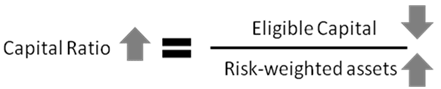
To summarise the difficulty banks will have in complying with the new higher proposed capital ratio requirement – the equation indicates the proposed capital ratio is to increase and is fixed, while the eligible capital (numerator) banks are accustomed to using (in order to achieve this ratio) is tightening (from a bank’s perspective), while the risk-weighted assets (denominator) are also tightening (from a bank’s perspective).
MACROPRUDENTIAL CONCERNS AROUND BASEL III(18)
Although Basel III proposes a strengthened common equity buffer as well as new liquidity requirements and a leverage cap, some scepticism does however remain. The counter-cyclical capital buffer along with the capital surcharge for systemically important financial institutions are the proposed tools to be used to achieve the macroprudential aims of Basel III. These elements or tools also proved most controversial, as it is without doubt the macroprudential aspects of Basel III that carries the most importance. The newly included macroprudential aspects of Basel III will at the end of the day receive the gratitude and praise in the instance that a financial crisis of some significant extent rears its ugly head in the future, or will it?
Some parties believe that Basel III is almost exclusively microprudential in focus, as they believe that Basel III is concerned with the solvency of individual banks rather than the resilience of the financial system as a whole.
We can almost say that there are three corners of supporters in this instance- parties that are of the opinion that Basel III:
- is microprudentially focused, or
- is macroprudentially focused, or
- attempts to be macroprudentially focused, but fails and thus turns out to be ‘leaning towards’ a microprudential focus
Followers of the microprudential corner feel that in general Basel III is focused too much on ‘loss absorption’, which by itself will be inadequate to achieve a stable financial system for the following reasons:
- Excessive asset growth (during economic expansion) is not directly addressed by loss absorption, and
- Preoccupation with loss absorbency diverts attention from the liabilities side of banks’ balance sheets as well as weaknesses from the dependence on unstable short-term funding and foreign currency debt
- This is, however, another focus area that falls outside the scope of this article. For a detailed reading into the arguments of why increased systemic risk is closely related to the interconnectedness of banks which in turn is a natural consequence of excessive asset growth, and why excessive asset growth and the delicateness of bank liabilities should be addressed by an effective macroprudential policy framework, please see Shin, 2010, “Macroprudential Policies Beyond Basel III”(19).
SOUTH AFRICAN BANKS & BASEL III(20)
A National Treasury discussion document is expected, in which guidance on the Basel III capital and liquidity requirements will be provided. This discussion document is to provide clarity on how South African banks should reach the required liquidity coverage ratio as well as the net funding ratio deadlines in 2015 and 2018 respectively. The document is also expected to (or should) clarify what the resulting actions will be if the set targets and deadlines are not met by local banks.
It is not difficult to see that South African banks will have a tough time of it during the not so distant future, as they strive to meet the required ratio targets and deadlines, albeit a possible easier time of it in comparison to many international banks. Some market participants are of the opinion that banks will find it difficult to achieve the targets, while some say banks will be forced to change their funding models (which are currently predominantly geared towards the wholesale market – as currently about one-third of the funding structure of South African banks are lying in this market). Unfortunately, wholesale deposits are not regarded as “stable enough” by Basel III and thus South African banks might be tasked with reinventing the attractiveness of retail savings in order to achieve the new Basel III liquidity target ratios.
At this stage, South African banks comfortably comply with the capital adequacy requirement of 9,5% (as set by the SARB), in that on average this stood at around 15% at the end of 2010. The liquidity and funding ratios, however, are the areas in which South African banks would need to improve dramatically.
The graph below presents the capital ratios of Big 4 South African Banks as well as the current SARB minimum requirement that is prescribed by the SARB under Basel II. The graph also provides an indication of the minimum requirement level that Basel III will bring forth – although this indication is before any SARB prescriptions.

TO CONCLUDE
So, after the dramatic turmoil that hit (arguable) global financial markets, whereafter many banks or financial services organisations closed their doors while some of the luckier few had the keys to the front door handed to government, we now have some action items on the agenda. This comes in the form of new banking regulations forever to be known as Basel III. Whether or not Basel III will be all that it is promising to be remains to be seen, but after all the talks, consultations and rework, it’s time to get to work as Basel III implementation is just around the corner. One thing, however, is certain – banks, including South African banks, will have to put in some hard work as there is a great deal of work to be done and possibly some difficult decisions to be made.
Works Cited & Endnotes
1)Krugman, P. 2009. The Return of Depression Economics and the Crisis of 2008. W.W. Norton Company Limited.
2)Greenspan, . March 26, 2009. We need a better cushion against risk. Financial Times. http://www.ft.com/cms/s/0/9c158a92-1a3c-11de-9f91-0000779fd2ac.html
3)Dinallo , E.R. March 30, 2009. We Modernised ourselves into this ice age. Financial Times. http://www.ft.com/cms/s/0/3b94938c-1d59-11de-9eb3-00144feabdc0.html
4)BCBS. December 2009. Strengthening the resilience of the banking sector (Consultative document). Bank for International Settlements. http://www.bis.org/publ/bcbs164.htm
5)BCBS. December 2009. International framework for liquidity risk measurement, standards and monitoring. (Consultative document). Bank for International Settlements. http://www.bis.org/publ/bcbs165.htm
6)BCBS. December 2009. Strengthening the resilience of the banking sector (Consultative document). Bank for International Settlements. http://www.bis.org/publ/bcbs164.htm
7)Brunsden, J. 12 Nov 2010. G-20 Leaders endorse Basel rules on banks’ capital, liquidity. Bloomberg. http://www.bloomberg.com/news/2010-11-12/g-20-leaders-endorse-basel-rules-on-banks-capital-liquidity.html
8)BCBS. s.a. International regulatory framework for banks (Basel III). Bank for International Settlements. http://www.bis.org/bcbs/basel3.htm
9)BCBS. s.a. International regulatory framework for banks (Basel III). Bank for International Settlements. http://www.bis.org/bcbs/basel3.htm
10)BCBS. s.a. International regulatory framework for banks (Basel III). Bank for International Settlements. http://www.bis.org/bcbs/basel3.htm
11)Source: KPMG. 2010. Basel 3: Pressure is building. www.kpmg.com
12)Anenberg, S.A., Forrester, J.P., Hawken, K., Horn, C.M., Kravitt, J.H.P. & Waack, D.S. 2011. Basel Committee Releases Final Text of Basel III Framework. www.mondaq.com
13)Harle, P., Heuser, M., Pfetsch, S & Poppensiker, T. 2010. Basel III : What the draft proposal might mean for European banking. http://ec.europa.eu
14)LCR Definition:
Stock of highly liquid assets |
Cash, central bank deposits, public sector securities |
High-quality corporate and covered bonds, rating >=A- |
High-quality corporate and covered bonds, rating AA- up to A |
Cash outflows over a 30-day stress period |
Stable deposits – retail/SME |
Less stable deposits – retail/SME |
Unsecured funding non-financial corporate (operational relationship) |
Unsecured funding non-financial corporate (no operational relationship) |
Other unsecured funding |
Due highly liquid repos |
Due other repos |
Committed credit lines non-financials/sovereigns |
Other committed credit lines/all liquidity facilities |
Potential outflows from derivatives |
Cash inflows |
Receivables from retail/business credit |
Due highly liquid reverse repos |
Due other reverse repos |
Other inflows |
|
Source: BCBS, Consultation Paper CD165 |
15)NSFR Definition:
Available amount of stable funding |
|
Required amount of stable funding |
Capital |
|
Fully liquid |
Long-term funding |
|
Highly liquid |
Stable deposits < 1 year |
|
Very liquid |
Wholesale funding < 1 year |
|
Liquid |
All other liabilities and other equity |
|
Less liquid |
|
|
Illiquid |
|
|
Off-balance sheet positions |
Source: BCBS, Consultation Paper CD165 |
||
16)KPMG. 2010. Basel 3: Pressure is building. www.kpmg.com
17)KPMG. 2010. Basel 3: Pressure is building. www.kpmg.com
18)Shin, H.S. 2010. Macroprudential Policies Beyond Basel III. International Centre for Financial Regulation.
19)Shin, H.S. 2010. Macroprudential Policies Beyond Basel III. International Centre for Financial Regulation. http://www.icffr.org/getdoc/3fa60720-1232-4d7d-8da6-0dcc3d0e9632/ICFR-FT-Research-Prize-2010-Hyun-Song-Shin---winni.aspx
20)Mittner, M. 2011. Banks in for a tough time. Financial Mail. 27 Jan.