JSE welcomes the exchange industry
By Victoria Williams
 or a few days in October this year, Johannesburg will be at the centre of the international exchange industry as the JSE hosts the World Federation of Exchanges’ 51st General Assembly and Annual Meeting. Known for being an industry think tank, this year’s annual meeting offers a full agenda from the regulatory winds in our industry, innovation in our businesses, market fragmentation trends and to the increased calls for integration and mergers which are central to the discussions.
 Rapid technological and regulatory change combined with competitive pressure from alternative marketplaces means that the exchange industry must evolve constantly to meet customer needs. These industry challenges have resulted in increased collaboration between exchanges, with the WFE central to these discussions.
In the aftermath of the global financial crisis, it’s not surprising that the need for increased regulation is central to the debate. “Today the exchange’s business is no longer simply about trading, clearing and settlement but also about playing a crucial part in ongoing financial intermediation,” comments Russell Loubser, CEO of the JSE and director and current treasurer of the WFE. “The exchange community has valuable experience to share in shaping regulatory reform and in maintaining a sound global economy and the WFE, as a respected professional body, provides the industry with the platform necessary to share their collective message among key policy makers around the globe.”
Regulatory responses in other major global competitor market places, in relation to increased transparency and regulation for alternative execution venues and OTC products, have direct implications for South Africa and the JSE. But regulation is not the only issue on the table. “This is a time of great innovation and change in the exchange industry. Much of this focus is on interest rate derivatives and extended clearing and risk management services which offer a new area of growth potential for exchanges,” says Loubser.
Innovation is also driven by technological change which has allowed for previously unheard of execution speeds and ways of trading that were simply unimaginable a few years ago. In an industry never shy of technical terms, new technology terminology abounds; dark pools of liquidity, high frequency trading and
co-location to site just a few. “Speed is becoming increasingly important in the exchange industry as exchanges cope with the rapid rise of high-frequency trading. Low latency trading systems will soon become a commodity,” says Loubser.
Increased competition as well as the required ongoing investment in technology has forced exchanges to consider the economies of scale that result from horizontal and vertical integration. Today’s exchanges have increasingly diversified businesses – selling an ever wider range of products and data to a wider range of customers. Exchange mergers have captured the headlines in recent months and are bound be discussed during these meetings. “The expected wave of consolidation activity is an indication of inevitable maturing of an industry but also a sign that exchanges are truly moving from being seen as single product national assets to increasingly global players,” notes Loubser. Some industry pundits predict that this is just the beginning of the exchange consolidation game. They anticipate further deals as global exchanges try to defend their market share against the growing competition, expand their exposure to emerging markets and achieve economies of scale and cost savings. Additional cited benefits are increased revenue, improved liquidity, and a greater foothold in an ever more competitive market. However, not everyone is convinced about purported merger benefits.
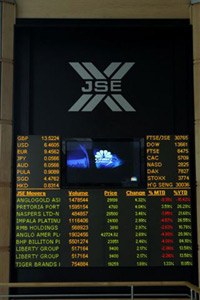 Spotlight on the JSE
As global investors increasingly turn to emerging markets, including Africa, it is appropriate that this years’ WFE meeting is held in Johannesburg. “This is a huge honour for the JSE. Many exchanges stand in line and compete for this honour, just like for the Olympics or the Soccer World Cup. Once you have earned the respect and confidence of the international stock exchange community, you are in contention. We are delighted that both the JSE and South Africa as a whole have earned the confidence and the respect of our peers,” says Loubser.
The JSE has operated as marketplace for the trading of financial products for 123 years. For the past 15 years the local bourse has been on a transformational journey; in that time it has evolved from a sluggish, poorly regulated equity exchange to a fully horizontally and vertically integrated one. As Africa’s only full service exchange, the JSE connects buyers and sellers in four different financial markets, namely equities, equity derivatives, commodity derivatives and interest rate instruments.
“What has been the most pleasing are the strides that the JSE has made in terms of market regulation,” says Loubser. According the World Economic Forum’s Global Competitiveness Report 2010-2011, South Africa’s securities exchange regulation has been judged to be the best in the world. “This accolade, for which our regulator, the Financial Services Board, should also take credit, reflects the enormity of the fundamental transformation of our industry,” says Loubser.
Although much has changed at the JSE during the past decade, there is significant work still to be done, given the rate of change in the global financial services industry. Large-scale technology projects are central to the JSE’s focus. The exchange has also invested heavily in information technology, spending over R2 billion in the past ten years on improving systems. In early 2012, the JSE plans to move its equity market trading activity onto the trading solution provided by MillenniumIT. When this system is implemented, JSE members are set to benefit from executing transactions almost 400 times faster than the present trading solution.
Loubser believes that the JSE can also play a role in attracting foreign inflows to the African continent in general: “Another key strategic focus for the exchange is to provide access to investors seeking to tap into Africa’s growth story. We believe that the JSE has the strategic links and technological capacity to act as a gateway into the continent. Launched in 2009, the JSE’s Africa Board offers a dual-listing venue for companies domiciled in Africa or with assets on the continent. “For investors, the board will offer access to African stock on a secure, cost effective trading platform,” says Loubser.
A Professional Body of Global Exchanges
The WFE is a trade association of 52 publicly regulated stock, futures and options exchanges and its members are responsible for the functioning of key components in the financial world. Stewarded by a board comprising CEOs and Chairmen of the world’s biggest exchanges, it is a central reference point for the securities industry worldwide and for individual exchanges.
WFE exchanges are home to more than 45 000 listed companies. Total market capitalisation of WFE members in 2010 amounted to USD 54.9 trillion, with approximately USD 63 trillion being traded on member exchanges in the same period. “Membership in the WFE is considered by some governments and national associations of asset managers as a prerequisite for preferential investment policy and taxation for these markets,” comments Loubser. To become a member, candidates are selected following a peer review and qualifying exchanges must then adhere to the WFE Membership Criteria.
The WFE has played a vital role in reinforcing the leading position of exchanges as the most attractive venue for listing and trading a growing range of securities and derivative contracts. In addition, the WFE works to promote the high quality standard of business adopted by all its members to a wider group of stakeholders including government, regulators and market users. It publishes monthly newsletters relating to relevant market statistics and business news; hosts public meetings and conferences to share expertise; sponsors research reports; and promotes overall standards for generally accepted principles of securities business conduct such as corporate governance.
Each year a different member exchange of the WFE hosts the General Assembly and Annual Meeting. NYSE Euronext hosted the 50th General Assembly in Paris October last year. 54 Countries, 68 Exchanges and six Associate clearing houses and self-regulatory organisations (SROs) were represented in Paris at the time.