Consumer financial education in South Africa
Anna Bouhail
SAIFM
Head: Education

 ince the establishment of democracy, government policies and initiatives have been aimed at developing a financially inclusive economy by eradicating the racially biased income and social inequalities in our society.
 Financial literacy and consumer protection have been identified as key factors in achieving these goals. Speaking at the opening of the Alliance for Financial Inclusion Global Policy Forum in Cape Town in September 2012, Minister of Finance, Pravin Gordhan stated: “As we continue to foster financial inclusion, consumer protection and financial education are fundamental to our efforts. An environment of poor financial literacy, coupled with a lack of adequate consumer protection, is likely to encourage consumer abuse and inappropriate use of financial services.”(1)
Consumer protection is promoted by various initiatives including the new regulatory regime in South Africa called the Twin Peaks Model of Regulation. The model, separating prudential and market conduct regulation, has proven (in countries such as the Netherlands and Australia) to increase consumer protection. The Financial Services Board (FSB) is also in the process of rolling out the “Treating Customers Fairly” regulatory initiative in a bid to promote customer protection.
Consumer education is also an important part of consumer protection and knowledge about the state of financial literacy among the population is essential for effective interventions. A recent baseline study on South Africa’s financial literacy  brought to the surface revealing facts about South Africans’ financial knowledge and behaviour. The baseline survey “Financial Literacy in South Africa”was the first of its kind in South Africa and was commissioned by the Consumer Education Department of the FSB as its own CFE initiatives have been hindered by a lack of data regarding the financial knowledge, attitudes, skills and behaviour of the South African consumer.
The Financial Services Board Act was amended in 2000 to mandate the FSB to promote CFE programmes and initiatives by the financial services industry and to inform and educate consumers (current and potential) of financial products and services. Under this statute, the FSB developed a CFE strategy document, accepted in October 2001. As part of its strategy, the Consumer Education Department of the FSB promotes the financial education of consumers in the formal education system as well as in the community. Financial literacy is currently incorporated into the national school curriculum with the FSB providing teacher and learner support. The department also facilitates numerous community workshops by invitation. Additional awareness in partnership with the short-term insurance industry association is created at bus and taxi ranks via various media channels. Various projects focusing on farmworkers, persons with disabilities, churches, trade union members and sport clubs are initiated on a continuous basis.
Nonetheless, from the baseline survey it is evident that a considerable number of South Africans still display very low levels of financial literacy and that financial participation lacks depth partly due to gaps in financial knowledge. Not surprisingly, higher-income households displayed higher levels of financial knowledge and prudence than their poorer counterparts. A significant divide between different population groups with regard to financial literacy is still evident. The baseline survey is concluded with the following statement “The results of this financial baseline study confirm the apprehensions of National Treasury. Not only did a considerable number of South Africans display very low levels of financial literacy, but only a minority relied on experts for financial advice and guidance. This suggests that a substantial proportion of the country's population may not be adequately equipped to make sound financial decisions. Indeed, the baseline study provides strong evidence for the existence of low levels of financial knowledge in South Africa. The findings of the study support a more comprehensive and aggressive programme of consumer financial education.”
The baseline survey provides descriptive findings organised around the areas representing important issues related to financial literacy. Underlying aspects have been associated with each domain to enable the researches to establish financial behavioural patterns. The framework of the survey is illustrated in Figure 1.
Figure 1: Financial Literacy Baseline Survey Framework

The financial literacy score for each of the four core domains as well as the overall financial literacy score is given in Figure 2.
Figure 2: Financial literacy score for South Africa
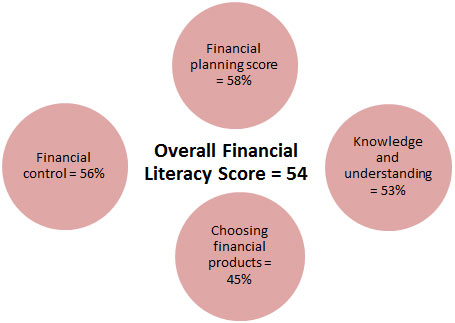
Source: Adapted from Financial Literacy in South Africa: Results of a national baseline survey 2012. Published by the FSB
The research contained in the survey was based on a pilot study carried out by the Organisation for Economic Cooperation and Development (OECD) in 2010. The sample size and sample population of the two studies was almost identical and the findings very similar. The asymmetry still present in the South African population with regard to financial literacy is evident from both reports. This is unfortunate as the financial sector was one of the first economic sectors to agree on a voluntary code of transformation with the implementation of the Financial Sector Charter on Broad-Based Black Economic Empowerment (B-BBEE). The Charter came into effect in January 2004 to address inequalities present in the financial sector. In terms of the first Charter, each financial institution committed from the effective date up to 2008 to invest annually a minimum of 0.2% of post-tax operating profits in consumer education.

Source: “Was the Financial Sector Charter (FSC) instrumental in driving Financial Inclusion in South Africa” (2)
After publication for public comment, the Financial Sector Code (FS Code) for Black Economic Empowerment was gazetted on 26 November 2012. It is based on a harmonisation of Generic Codes and the Financial  Sector Charter. The FS Code constitutes the foundation on which companies operating in the financial sector will be measured for B-BBEE compliance.
The Financial Sector Charter was published as a Transformation Charter under section 12 of the B-BBEE Act and participation was thus voluntary. However, the FS Code was published under Section 9(1) of the B-BBEE act and is thus binding and takes precedence over any other Code including the B-BBEE Act’s Generic Codes of Good Practice (CoGP). The CoGP is applicable only to the extent that the FS Code is silent on a particular aspect of B-BBEE that is covered in the CoGP(3).
The commencement date of the FS Code was 1 January 2012. It is applicable to all measurement periods commencing on or after 1 January 2012 and ending prior to 31 December 2017 (when a full review of progress made against the sector code will be undertaken by the Minister of Trade and Industry and the Minister of Finance).
The CFE quantum and quality specifications as stipulated by the FS Code applicable to the different companies in the financial sector are outlined in Table 1. Collective Investment Schemes (CIS) have not been included in the scope of this measurement as these Schemes, according to the FS Code, do not represent an ideal solution to cater for the savings requirements of consumers earning under the tax threshold, as typical CIS products do not fit the financial requirements of lower income consumers. Companies with annual total revenue of equal to or less than R5 million qualify as an Exempted Micro-Enterprise and are deemed to have B-BBEE status of a level four contributor. These companies are allowed to be measured in terms of the Qualifying Small Financial Institutions Scorecard should they wish to maximise their points and move to the next recognition level.
Table 1: CFE quantum and quality specification as per the FS Code
|
Members of the Banking Association of South Africa and Qualifying Small Financial Institutions (QSFI)(4) |
Long term assurers |
Short-term assurers |
Qualifying market |
The target market for consumer education will be individuals in the LSM 1-8 group with the major emphasis on the LSM 1 - 5 category. The LSM 6 - 8 group is included as they were the most affected by the financial crisis. |
The target market for Life products will be based on income and pegged at the tax threshold for individuals and double the tax threshold for families. The target market definition is to be adjusted annually, based on changes to tax threshold. The tax threshold currently stands at just under R60 000 per annum. |
The metric has been broadly based on products aimed at individuals earning below the tax threshold, households with an income below double the tax threshold and Black small businesses and small Black farmers. The target market for individuals and households will be adjusted based on changes to the tax threshold. |
Point allocation |
2 out of 14 |
Qualifying criteria |
Consumer, Primary and Basic Education |
Range |
National |
Products |
Products and services will be closely aligned with the standards, products and services developed and maintained by the FSB as designated owners of consumer education by the National Treasury. Until that alignment has been fully achieved, the current products and services will prevail with the standards as set out under measurements being in force. |
Not specified in Financial Sector Code |
Not specified in Financial Sector Code |
Measurement |
As per the Consumer Education standards as set out in the Guidance Notes. In addition the following shall be adhered to:
- That delivery is split between awareness and face to face initiatives at a ratio of 1:1.
- Accreditation will not be a requirement provided the next condition is adhered to.
- Full branding of printed material, in order to deter institutions from using service providers with little or no credibility or material of sub-standard level.
|
Not specified in Financial Sector Code |
Consumer Education standards will be determined following the gazetting of the FS Code. |
Targets |
Measurement will be against an annual target of 0.25% for 2012, 0.3% for 2013 and 0.4% from 2014 of retail net profit after tax (NPAT) |
A company will score 2 points for Consumer Education spending of 0.4% of post-tax operating profits and proportionately for anything less. |
Measurement will be against an annual target of 0.25% in year 1, 0.3% for year 2 and 3 and 0.4% from year 4 of retail net profit after tax (NPAT). |
The lack of efficacy of the CFE initiatives has been attributed to a number of structural issues, which include
- the lack of co-ordinated and consistent legislative interventions in consumer financial education. Various government departments and institutions have been given legislative mandates to promote and/or implement financial education programmes for consumers
- current consumer financial education programmes in South Africa are fragmented, lack impact and do not make effective use of the limited resources available.
Recognising that the following prerequisites are needed in order to improve co-ordination amongst role players and to maintain the appropriateness of CFE programmes, National Treasury has established the National Consumer Financial Education Committee:
- The need for a framework for collaboration and co-ordination of financial sector stakeholders in financial education
- The provision of data and measurement of financial education programmes to determine whether policy and programme objectives are being achieved.
It has been recognised that the ultimate goal of CFE is to improve consumers’ financial well-being by helping them to
- understand financial management which will assist in appropriate decision making
- monitor the market conduct of financial institutions through their decisions and use of recourse facilities
- face their ever-increasing responsibilities as a result of the growing complexity of financial products and the transfer of financial risk to consumers
- know where to look for important information, objective advice or access to recourse facilities.
Members of the Committee are
- financial industry associations, such as the Association of Savings and Investment SA, the Banking Association of South Africa, the South African Insurance Association and the Association of Black Securities and Investment Professionals
- the FSB and government departments such as Basic and Higher education
- labour and community representatives.
The mandate of the Committee is to
- finalise national consumer financial education policy
- develop the national consumer financial education strategy
- oversee implementation of the strategy
- review the national consumer financial education strategy on an annual basis to ensure its relevance.
The baseline survey will assist the committee to assess the achievement of strategy and guide the development of future strategy and thereby the implementation of future CFE programmes. It is also anticipated that the survey will be repeated in the next three to five years to assess the impact of efforts to increase financial literacy levels.
The commitment shown to these issues is sure to bring about an improvement in the financial literacy of the population by granting them the skills to manage their own finances more efficiently, while abusive practices in the financial sector will be eradicated or if not, at least minimised.
The commitment shown to these issues is sure to bring about an improvement in the financial literacy of the population by granting them the skills to manage their own finances more efficiently, while abusive practices in the financial sector will be eradicated or if not, at least minimised.
(1) Alliance for Financial Inclusion; Global Policy Forum. September 2012. Making Financial Inclusion Real. Opening Address by Pravin Gordhan, Minister of Finance, South Africa. Available at: http://www.treasury.gov.za/comm_media/speeches/2012/2012092701.pdf. (Accessed during March 2013)
(2) An article written by Thabo Tlaba Mokoena. Published in “Embedding Financial Inclusion”. Supplement published by the Banking Association South Africa. Sep 2012.
(3)Notice 997 of 2012: Codes of Good practice on Broad Based Black economic empowerment. Preamble, Status of this Code, pages3 and 4.
(4) A financial institution with designated investments of less than R50 million and an annual turnover with a value of less than R35 million.
Bibliography
Alliance for Financial Inclusion Global Policy Forum: Making Financial Inclusion Real. September 2012. Opening address by Pravin Gordhan, Minister of Finance, South Africa.
Financial Literacy in South Africa: Results of a national baseline survey 2012. Published by the Financial Services Board Available at: ftp://ftp.fsb.co.za/public/Consumer%20Education/Financial%20Literacy%20Booklet%202012.pdf (Accessed during April 2013)
Financial literacy in South Africa: Results of an OECD/INFE pilot study. 9 June 2011. Available at: ftp://ftp.fsb.co.za/public/Consumer%20Education/Reports/FSBFINANCIALLITERACYREPORT09June2011ExecutiveSummary.pdf (Accessed during April 2013)
The Consumer Education Initiative of the Financial Services Board Final Strategy. 14 October 2001. Available at: ftp://ftp.fsb.co.za/public/latest_news/Storyreportv3.pdf. (Accessed during April 2013)
FinMark Trust. November 2005. Preliminary principles for expanding consumer financial literacy in SA. source
Greenblo, Allan. 13 March 2013. Article: Education is empowerment. Available at: http://www.moneyweb.co.za/moneyweb soapbox/education-is-empowerment?sn=2009+Detail+no+image. (Accessed during March 2013).
Notice 997 of 2012: Codes of Good practice on Broad Based Black economic empowerment.
South African Reserve Bank (KBP6200J, KBP6201J, KBP6202J, KBP6006J), DNA Economi