A Financial Conditions
Index for South Africa
By Christo Luüs
Ecoquant (Pty) Ltd

 With
the repo and prime overdraft rates having risen by 400 basis points since
June 2006, financial conditions are generally considered to be tighter
now than they were a year ago. However, looking at a wider measure of
financial conditions, conditions in general do not appear to have become
much tighter, and interest rate increases have thus far had a fairly limited
impact on broadly measured financial conditions.
 It
is generally considered that a tightening in monetary policy will slow
demand in the economy as credit becomes more expensive. Not only will
demand for credit-financed purchases diminish, but the “crowding-out”
of non-credit related purchases through increased interest costs could
also cause an easing in the demand for other goods and services. The ultimate
aim of such monetary policy tightening will be to reduce inflation, although
an unintended consequence of this could also be a slowdown in the rate
of economic growth. But monetary policy and its wider impact through the
so-called transmission mechanism, is a rather complex process, and can
take between 12 and 24 months to affect the rate of inflation.
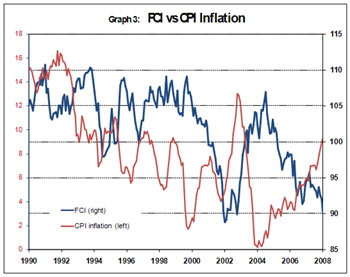
However, the interest rate is not the only variable which affects financial conditions. Internationally, analysts have often attempted to identify and measure some of the other factors which have an impact on financial conditions, hence the approach to develop a Financial Conditions Index (FCI).
The aim of a Financial
Conditions Index
It is an often overlooked fact that higher interest rates in nominal terms
may not imply higher rates in real terms if inflation is accelerating
at the same time. Under such conditions, inflation may take longer to
be brought under control. What is more, a stricter interest rate policy
may be partially or even entirely neutralised by real exchange rate movements
(such as a currency weakening brought about by external factors), or if
credit demand accelerates even in the face of higher interest rates. A
Financial Conditions Index can signal overall financial conditions to
economic agents, and can serve as a rough indicator for the conduct of
monetary policy – especially in times of high financial market volatility.
A FCI, which is updated on a monthly basis, therefore gives a comprehensive
view on the financial variables likely to impact on both future inflation
and economic activity levels.
Constituent factors and
weights
The following factors were identified as constituents of a Financial Conditions
Index (FCI) for South Africa:
- Real short-term interest rates.
Nominal interest rate
 changes
are keenly observed by economic agents. It is the single most important
policy instrument of the monetary authorities, and is used to signal
whether they anticipate higher, lower or stable inflation conditions
ahead. Real interest rate changes (nominal rates adjusted for current
inflation) are expected to have an effect on future inflation with
some time lag.
- Yield spread. A yield curve is considered "normal" (positive yield spread) when short-term interest rates are lower than interest paid on investments with longer maturities. The reason is that the market usually expects more compensation for greater risk. Longer-term bonds are exposed to more risks such as changes in interest rates and an increased exposure to potential defaults. Investing money for a long period of time means that an investor is unable to use the money in other ways, therefore the investor wants to be compensated for this through the time value of money component of the yield. When a yield curve becomes inverted, it usually means that the monetary authorities have an aggressive approach towards fighting inflation and that investors generally believe that future inflation will go down.
- Excess money supply growth. Credit and general liquidity conditions can be gauged by the extent to which money supply growth (M3) exceeds the nominal growth in GDP. “Easy” credit conditions are usually reflected by high levels of money creation in the economy, which could become inflationary and may prompt a policy response.
- Company earnings yields. There are four ways in which changes in asset prices – and especially share prices – influence economic activity: through wealth effects; through effects on capital costs; through effects on companies’ balance sheets; and through expectation effects, i.e. the degree of optimism or pessimism of consumers and entrepreneurs. The stock exchange earnings yield (inverse of the price/earnings ratio) is used to serve as an indicator of the degree that share prices are under- or overvalued.
- Real effective exchange rate movements.
A country’s currency is usually affected by interest
 rate
movements since both financial and real sector activity are influenced
by financing costs and inflation expectations. But there can be times
when, for example, real interest rates may be rising, while external
factors may at the same time be causing the currency to depreciate.
The overall impact on monetary policy could then be neutral, since
the stimulation provided by higher exports may feed through to production
and investment, and even cause GDP growth to accelerate.
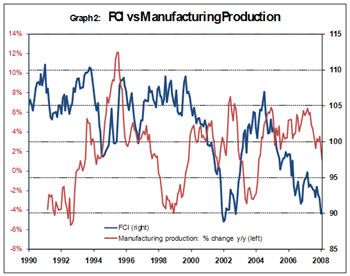
The above variables were indexed, standardised, and rebased over the period 1997-2007. They were also regressed on manufacturing production over the period 1990-2007, with the variables’ coefficients used to give an approximation of the relative weights to be attached to each of the components. The following weights were given to the components:
Real interest rate: 30%
Excess money supply growth: 30%
Real effective exchange rate: 25%
Company earnings yield: 10%
Yield spread: 5%
 Change
in financial conditions — recent SA experience
As can be seen from graph 1, overall financial conditions have remained
fairly tight during most of the 1990s, with a significant easing taking
place in 2001-2003 mainly as a result of the sharp depreciation in the
rand. With money supply growth coming under pressure and the real effective
exchange rate peaking by mid-2004, financial conditions experienced a
brief tightening phase, before the force of lower interest rates started
having a material effect on financial conditions. Soon excess money supply
growth started to accelerate, the rand weakened slightly, and share prices
started to rise.
Since June 2006, interest rates have risen by 400 basis points, but in real terms the prime overdraft rate has declined substantially: it was 6% in real terms in May 2006, and stood at 4,7% in February 2008. In addition, money supply growth has continued to outstrip real GDP growth by a wide margin and even accelerated in the final quarter of 2007, topping nominal GDP growth by around 12% (compared to an average of 2% since 1980). Although the real effective exchange rate showed very little movement during 2007, strengthening slightly by 2,7% between December 2006 and 2007, the early months of 2008 saw some significant weakening in the currency. The only variable which indicated some tightening in financial conditions had been the JSE All-share earnings yield, which rose from 5,8% at the beginning of 2007, to 7,2% at the beginning of 2008. Overall, the combination of these factors tended to lead to an easing in financial conditions, neutralising the tightening effect that rising nominal interest rates could have had.
Conclusion and implications
Recent interest rate increases have been inadequate to match the rise
in inflation, and probably brought pressure to bear on the exchange rate.
Despite higher nominal interest rates, money creation continued unabated,
although stock market valuations did suffer somewhat. The result is that
overall financial conditions as measured by the FCI, has not tightened
materially (based on February 2008 numbers), and interest rates may very
well have to rise further to counter the potential inflationary impact
of the relatively “easy” financial conditions. Given the current
stance and outlook for overall financial conditions, GDP growth could
be adversely affected. Household spending growth is likely to moderate
further, but capital formation growth may remain above trend.