


Arguably, decarbonisation itself can be viewed as a special purpose vehicle (SPV) of “green transition” purposively designed to steer humanity to the futuristic destination of a “climate-smart world” through ecological highway of green capitalism’s sustainable development agenda. As a complementary reflection of that ethos, the Johannesburg Stock Exchange (JSE) established JSE Ventures as a stand-alone SPV to provide a market-based mechanism to reach the destination of a low-carbon world through provision of global carbon credits to local firms to mitigate their emissions in compliance with the Nationally Determined Contributions (NDCs) enshrined in the global 2015 Paris Agreement which locally translated into the Carbon Trading Act 15 of 2019 and subsequently reinforced by the Climate Change Act 22 of 2024 and ultimately codified by JSE Ventures’ Voluntary Carbon Market (VCM) . To achieve this ambitious task, JSE Ventures partnered with Xpansiv, a global digital platform provider for environmental assets. Jointly, the partners are preaching the ecological gospel of climate change aversion wherein decarbonisation is presented as the truth, green capitalism as the way and the low-carbon reality of sustainable (green) production and (green) consumption as the very life.
Evidence of Efficacy of Mature Carbon Markets in Emissions Reductions
JSE Ventures’ Voluntary Carbon Market (VCM) is still in its infancy as it was only established in November 2023 and needs more longitudinal monitoring. However, when voluntary sustainability corporate practices are combined with supportive legislation such as the Carbon Trading Act 15 of 2019 and the Climate Change Act 22 of 2024, they positively conspire to create a virtuous cycle wherein voluntary sustainability practices make it easier for firms to comply with mandatory sustainability regulations which in turn reinforce the pre-existing private obligations under the regime of Environmental, Social and Governance (ESG) compliance and reporting thereof.
Assuming all signatories to the Paris Agreement cooperatively implement their Nationally Determined Contributions (NDCs), economic efficiency gains in the sum of US$300 billion per annum can be harvested in 2030 (Mehling, 2024). At the same time, the European Union (EU)’s Emissions Trading Scheme (ETS) has achieved an effective 20% drop in emissions from the European power sector since its 2005 inception without any trade-off in economic growth (Bayer & Aklin, 2020). In the Americas, California’s cap-and-trade programme and, in Asia, China’s national carbon market lend hitting-two-birds-with-one-stone evidence that carbon pricing can reduce emissions while preserving economic efficiency (Kohlscheen et al, 2024). This is supported by Chen, Zhang and Huang (2021) who categorically assert that California’s cap-and-trade programme and China’s national carbon market have actually succeeded in breaking fossilistic capitalism’s link that increased economic activity and economic growth thereof comes with increased emissions.
Over and above the emissions-reduction narrative, carbon credits have gone out of their way and successfully demonstrated co-benefits for sustainable development as exemplified by India’s Bagepalli Biogas project which, despite significant reductions in methane emissions to the tune of 50,000 metric tonnes of carbon dioxide annually, simultaneously provided clean energy to 5,000 households (Madheswaran et al, 2024). The ecological spillover effects of this project were the massive improvements in indoor air quality and related public health through limiting vectors for air-borne infections. Similar biospheric benefits were recorded in the Netherlands-sponsored Reforestation of Degraded land in Romania which managed to simultaneously achieved carbon sequestration together with biodiversity restoration and employment creation.
Evidence of Carbon Credits Efficacy in Africa
Due to historically embedded and structural reasons manifesting as, among others, regulatory incoherence due to statutory fragmentation, limited institutional capacity compounded by minimal access to climate finance and climate tech, generally poor implementational capabilities in translation of strategies into practical action followed by equally limited access to digital technologies for effective monitoring and verification, the African continent remains on the backfoot of the global carbon market. For example, energy consumption for 47 countries in Africa equates to that of Spain, a small European country. Still worse, a mere 3% of carbon credits are issued from the continent due to limited access to green finance.
However, a sustainability-based renaissance has been birthed to accelerate participation in carbon markets embodied in such initiatives as the Africa Carbon Market Initiative (ACMI) launched at COP27 with the express aim of unlocking the continent’s carbon market potential which Bedair et al (2023) estimate could reach 300 million carbon credits by 2030 and 1.5 billion by 2050. Given Africa’s natural endowments of forests, ACMI believes that approximately 2,000 metric tonnes of carbon dioxide equivalents (MtCO2e) can be generated by Africa.
The following section examines the impact of carbon credits generated from the United Nations (UN)-backed framework described as Reducing Emissions from Deforestation and Forest Degradation (REDD)+ and its Projects in Africa among the countries of Zimbabwe, South Africa, Kenya, Ghana and Nigeria. The REDD+ projects seek to mitigate climate change through reducing deforestation.
In Kenya, an estimated 26 million carbon credits have been generated from various REDD+ projects. Courtesy of green finance availed by South Africa’s Nedbank, the Kasigau Wildlife Corridor project, for example, has generated US$180 million of revenue from the 18 million carbon credits accounting for 69% of Kenya’s carbon credits of 26 million. This REDD+ project spans 500 000 acres of dryland between Tsavo East and West National Parks and has also had co-benefits of developmentally empowering 100,000 community members while ensuring biodiversity conservation and emission reduction at the same time. Experts estimate that by 2030, this REDD+ project is well able to generate an annual quantum of 20 – 25 million credits projected.
In West Africa, Ghana has already generated 37.5% of its allocated carbon credits, being 24 million metric tonnes of carbon credits which can be sold out of its cap of 64 million metric tonnes as provisioned under Article 6.2 of the Paris Agreement. These credits came from an assortment of projects with the clean cookstove dominating the narrative with ambitious projections of distributing 9.1 clean cooking stoves by the year 2030. Ghana has adopted a regulatory approach through the creation of the Ghana Carbon Registry (GCR) focused on tracking and recording information in the issuance, transfer and use of internationally transferred mitigation outcomes (ITMOs) (Michaelowa et al, 2023).
As the most advanced nation on the African continent, South Africa has the most structured approach combining regulatory provisions from the Carbon Trading Act 15 of 2019 and the Climate Change Act 22 of 2024 which work jointly with the ESG practices administered by the JSE culminating in the recent institutionalisation of the Voluntary Carbon Market (VCM) launched by JSE Ventures in November 2023. Firms in South Africa are enjoying virtuous cycle of having the opportunity to offset, legally under the rule of Carbon Trading Act (CTA), up to 10 – 15% of taxable emissions with approved credits while also participating in the VCM where they can purchase credits to meet their net-zero (carbon neutrality) or ESG reporting requirements. During CTA’s phase 1 period of 2019 – 2025, a total of 4 million carbon credits per year was recorded up to 2022 when the steady trajectory declined before slight market correction in 2023. Of course, speculative behaviour of hoarding carbon credits in anticipation of increased future carbon tax rates by the South African Revenue Service (SARS) was observed during this period as indeed confirmed by the shift from the inaugural carbon tax rate of R120/tCO2e in 2019 to the current levels of R190/tCO2e.
With a view to achieving its both its interim industry-specific 2030 goal of zero routine flaring and venting which in turn reduce emissions of methane gas and national 2060 net-zero objective, Africa’s biggest economy, Nigeria has imposed a carbon price in the form of its national flaring tax of US$3.50 per thousand standard cubic feet for the oil and gas industry, which was revised under the Petroleum Industry Act of 2021. However, the US$3.50 tax is not expressed in terms of GHG emissions directly.
Furthermore, under the Verra registry, Nigeria has a total of 13 decarbonisation projects at various stages ranging from feasibility, verification and production. The projects cover transport at 23% (use of electric hybrids as fossil fuel substitutes in trucks, forklifts, mobile equipment, vehicles and machinery), Agriculture, Forestry and other Land Use (AFOLU) at 46% (involving adoption of regenerative agricultural practices, forest and national park conservation, agricultural waste recycling and production of biochar) and energy demand at the remaining 31% covering solar PV installations, substitution of traditional air-conditioning (aircon) with inverter aircon, clean cooking technologies like improved cookstoves and replacement of fossil-based generators.
Post-pandemic conservative estimates from the World Bank’s Carbon Pricing Leadership Coalition claim that over 1.5 million carbon credits have been generated in Nigeria to date from various projects.
Zimbabwe’s flagship sustainability project is the Kariba Forest Protection initiative, branded Kariba REDD+ project covering 785, 000 hectares of forest which offset approximately 4 MtCO2e (Verra, 2022). Its 27 million carbon credits were purchased by renowned brands such as Gucci, Volkswagen, Nestle and Dutch electricity firm, Greenchoice who utilised them to offset their own emissions as part of their carbon-neutrality strategies of achieving net zero compliance status. In the process, the project generated well in excess of US$100 million in revenue. However, following allegations of creative accounting in the estimation of carbon credits by Global Carbon Investments (GCI) as project developer, and attendant exaggeration of developmental impact thereof to the local community, a total of 57% of the 27 million carbon credits (15.39 million) were reportedly “in excess” or fraudulent. This highlights the intrinsic risks of carbon credits which have been repeatedly observed in the REDD+ projects elsewhere.
Despite the various decarbonisation initiatives highlighted in the foregoing, the World Bank reports the 2011 – 2022 emissions trajectory for these five countries as set forth below:
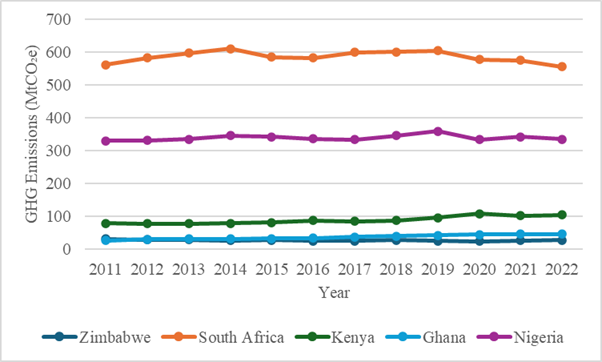
Fig 1.1: Sub-Saharan Africa’s GHG Emissions Trajectory, 2011-2022 (World Bank Data).
The generally upward trend in emissions above can be contrasted with the more heterogeneously volatile carbon credit issuance for the same period under review thusly:
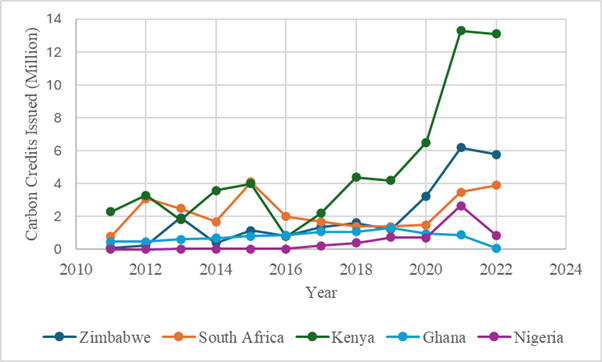
Figure 1.2 Trajectory of Carbon Credit Issuance in Sub-Saharan Africa 2011–2022 (Verra Registry / Gold Standard Database)
East Africa, as represented by Kenya, seems to be the most active in its carbon market participation in comparison to its peers in West and Southern Africa.
The exponential rise in carbon initiatives in Africa and the empirically limited and fragmented evidence of carbon credits efficacy in emissions reduction on the continent could well be attributable to a trinity of factors. In the first place, the obsession with project-level analysis with a focus on observability of co-benefits accrued at the micro-level of the communities impacted within the 50km geographic radius of the projects tends to lose sight of the aggregate national emissions impact of the same projects. This is further aggravated by the fallacious toddler-versus-adult comparison of matured carbon markets in Europe, America and Asia with the nascent African carbon markets marked by relatively weaker structural provisions in the form of institutional capacity, regulatory frameworks and economic coherence and integrity. Finally, the sheer paucity of robust econometric modeling studies on the continent’s maiden carbon markets promotes the prevailing non-efficacy bias.
Perhaps JSE Ventures, as the continent’s seminal Voluntary Carbon Market (VCM) in collaboration with research institutions, should elevate the visibility of carbon credits as a market-based intervention in climate change mitigation.
