


 |
||
Trans-Limpopo Arbitrage: Unlocking Value in Cross-Border DifferencesBy BS MANWERE, (MIFM)
Basis of ArbitrageWhile the world has increasingly become a global village courtesy of ground-breaking innovations in transportation and technology, and while the death-of-distance mantra echoes all over the planet with the implications that arbitrage opportunities are gone, there is, notwithstanding, much room for exploiting cross border differences. It is admittedly true that geographic distance no longer poses a barrier to trade. However, as Pankaj Ghemawat (2003) maintains in his article The Forgotten Strategy, the notion of distance should not be measured in terms of geographical yardsticks such as miles and kilometres. Rather, distance exists as long as there are cross border differences in whatever form. As long as cultures, administrative regimes, geographical separations and economic fundamentals differ from one investment destination to another, there is still scope for arbitrage. The four pillars of culture, administration, geography and economics are the basis of the framework acronymed CAGE which asserts that distance still exists under the guise of differences in the elements of the said CAGE Framework. That explains why Jamaican cultural music, made in the Caribbean, is consumed all over the world. Places such as the Cayman Islands, with their relaxed regulatory and administrative laws, have become home to multinational companies from the rest of the world, while the Netherlands, with their good horticultural climate, still supply flowers all over the world. On the economic front, one witnesses massive tides of funds flowing back and forth from developed to emerging markets as investors pursue price differentials. That explains why arbitrage is commonly described as the strategy of difference. The colonisation of Africa, as a continent endowed with rich natural resources, can be traced back to arbitrage-driven ambitions. Rationale for Trans – Limpopo ArbitrageThe Zimbabwean financial markets appear to be in the base-building stage which comes in the wake of stock market crashes. While the analysis of the anatomy of financial market crashes is beyond this article, what is important to note is that, as with all cycles, after the crash then comes recovery. While the dark clouds of political anxiety threaten to eclipse the rising sun of economic opportunity in Zimbabwe, shrewd international investors have already commenced the march towards establishing footholds in the economy. The negativity surrounding the country as an investment destination has only allowed visionary entrepreneurs to bargain and thus acquire stakes on a discounted platter. For income and growth oriented investors placing their funds in the money and capital markets respectively, significant premiums are realisable. Currently, money market rates offered by commercial banks(1) on United States dollar (USD) denominated deposits stand at an average of 12% per annum. Similarly, the average return on the Zimbabwe Stock Exchange (ZSE) Industrial Index is 23.2%(2) per annum. Base-building, as explained in the foregoing, comes in the wake of Kindleberger’s eight stage chronological sequence of the unfolding of stock market crashes. This model, adapted from Minsky, starts with a triggering shock and is summarised below;
While the determination of the precise event which could be pinned down as the Initial Trigger is invariably controversial as several incidents in the financial markets can and do contribute to external shocks which ignite booms, the point at issue is that after the financial markets experience some exogenous agitations, an eight phased motion is set in. Inflationary demand for assets accompanied by rising prices sets in at the third stage as the investors become excited. As exaggerated expectations of get-rich-quick pauper-to-millionaire realities gain momentum, a frenzy of buying is born at the fourth stage. The prospects of making easy money are so real that it is difficult even for the most conservative critics to stay unruffled. As dramatic stories of how easy it is to make money on the stock market dominate the news headlines, the unsuspecting members of the general public join bandwagon of buyers, thereby buying at the peak from knowledgeable investors, some of whom begin to sell off their holdings at this fifth stage. Doubts begin to set in at the sixth stage as prices recede from the peak. At the seventh stage a massive tide of selling ensues as the naked reality dawns on the investing public that the bubble is bursting. The final stage witnesses the collapse of the boom. As the curtain closes on the drama, the investment stage is seen littered with carcasses of bankrupt firms and heartbroken individuals whose dreams have been irreversibly shattered. The courts become clogged with lawsuits. Debt deflation sets in. However, as the dust settles, base-building starts. The foregoing eight-phase sequence as articulated by Kindleberger has already come and gone in Zimbabwe and the stage is ripe for recovery. Entrepreneurial investors who do not want to come in at the fifth stage when the gullible public is lured into the financial markets to irrationally buy-high-and-sell-low have only today to act while the investment scarecrow of political uncertainty overshadows the premium returns behind the financial landscape.
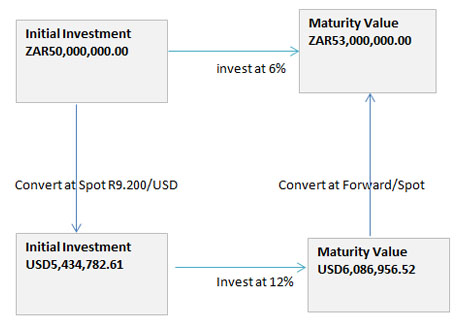
Take R50 million for instance. A Fund Manager (FM) in South Africa can place the same in the money market for 12 months at a rate of approximately 6%. Using the following basic formula used in mathematics of finance; PV (1+r) n = FV At the end of the year, the investment grows to R53, 000,000.00. Alternatively, they can invest north of the Limpopo where interest rates are 12% per annum on United States dollar-denominated deposits. However, the FM will need to first convert the South African Rand (ZAR) at the prevailing spot exchange rate of R9.2200/USD. The USD equivalent becomes USD5, 434,782.61, which amounts to USD 6,086,956.52 on maturity. The diagram below illustrates the process;
As such, at this point one cannot determine which strategy has generated more return on investment. Is R53, 000,000.00 a year from now worth more than USD6, 086,956.52 12 months hence? The questions cannot be answered without looking at the expected exchange rate. How much will the spot exchange rate be in a year’s time? What is the 12 month forecast of the ZAR/USD? Alternatively, one could also ask, what is the one year ZAR/USD Forward rate? If one compares these 2 future values (FVs) there is an implied exchange rate between the USD and ZAR. In this case, it is R8.7071/USD. However, if the expected future spot exchange is rate 10.03, the FM can convert the USD investment into ZAR and realise R61, 052,173.91. The table below summarises the returns; Scenario 1: Rand Forecast 12 month Exchange rate at 10.0300
As can be seen from the table, if the FM hedges the foreign exchange risk with a forward contract, and is therefore able to convert the ZIM investment back into ZAR on maturity, they realise a return of 22.10%, which is a premium 16.10% above the return on the SA Money Market. Given a Historical Data Test Forecast Accuracy (HDTFA) of 1.2300 on the forecast spot exchange rate of 10.03, it means that on average, the exchange rate of the South African Rand against the United States dollar will be within 1.2300 currency units of the forecast. Therefore the forecast spot exchange rate can either be 8.8000 or 11.2600. Using these spot exchange rates on either side of the forecast mean, the following results obtain; Scenario 2: Rand Forecast 12 month Exchange rate at 8.8000
If the South African rand appreciates in 12 months time to around ZAR8.8000/USD, the premium will be reduced. Scenario 3: Rand Forecast 12 month Exchange rate at 11.2600
Should the Rand depreciate significantly a year from now, the cross-border arbitrage strategy will provide a premium of 23.32% above the 6% money market rate in South Africa. Obviously, the foregoing analysis is based on assumptions about the term structure of interest rates. Moreover, in the money market, one would invest for perhaps one to three months periods. Notwithstanding, the same financial implications will hold on reduced tenor, especially as shorter investment periods have less likelihood of seeing huge swings in macroeconomic fundamentals. Risks in Trans-Limpopo ArbitrageAccording to Portfolio Theory which assumes that rational investors prefer to hold a number of assets (portfolio) as opposed to just a single security, investors are confronted by two broad categories of risk namely systematic and unsystematic risk. Systematic risk, which is inherent in all economic activities, derives from the economy or market in which investors operate and cannot be eliminated through diversification. On the other hand unsystematic risk happens to be firm-specific and can therefore be totally eliminated through holding different investment assets which offset one another’s risk through less-than-perfect correlation. Therefore unsystematic risk is accordingly known as diversifiable risk. Since unsystematic risk can be done away with, investors need not worry about it. The risk which is of great concern is the non-diversifiable systematic risk. The Capital Asset Pricing Model (CAPM) summarises the risk-return relationship in a simple equation as follows; Re = Rf + B(Rm – Rf) The expected return from a risky asset depends on the risk free rate of interest, traditionally benchmarked as the Treasury Bill (TB) rate, the expected return from the market portfolio and the degree of correlation between the asset and the market as a whole. For an investor to get a higher return, they require to bear an increased amount of risk corresponding to that return. The portion (Rm – Rf) in the equation represents the risk premium, which is the excess return over and above the risk free rate of return. Orthodox financial economics maintains that Treasury Bills are risk free because the Government cannot default on account of access to seignorage (the capacity to print money). Furthermore, the State can resort to digging-a-new-pit-to-fill-an-old-one antics of debt refinancing where new debt instruments are issued to retire old debt obligations. However, these measures have their own inflation implications, which are beyond the scope of this article. Notwithstanding, it is not always true that the Government cannot default, as the case of the Zimbabwean Government shows. This section will look at the risks that investors contemplating investing across the Limpopo should be extremely wary of. Liquidity RiskThis is a serious risk which South African investors may encounter. Zimbabwean financial institutions may be unable in the short term to meet their financial obligations when they fall due. This is worsened by the fact that the Reserve Bank of Zimbabwe (RBZ)’s policies are running completely afoul of the conventional requirements for financial institutions to trade in the inter-bank market. The repeated increases in statutory reserves have left the banking sector with limited space to increase money supply through the lending process. The increase in capital requirements from USD12.5million for merchant and commercial banks to USD25million in 2012 within a year, with an increase to USD100million by 2014 has left the financial sector crippled by liquidity problems. The majority of the small banks are only left with the option of merging. Therefore should a South African institution place their funds with a Zimbabwean bank, for instance, there is a possibility that the bank may fail to pay back both principal and interest on maturity. This Liquidity risk is aggravated by the fact that, at a national level, the Government itself cannot resort to seignorage with respect to the United States dollar, which happens to be an adopted currency. The liquidity risk is further compounded by scant foreign exchange reserves which are less than one month’s imports. Credit RiskStandard & Poor’s, Fitch and Moody’s all rank South Africa’s credit rating outlook as stable with corresponding ratings of BBB, BBB and Baa1 respectively. On the other hand, Zimbabwe is not rated. Considering the fact that three institutions mentioned above are among the best in the world, their reluctance to provide a rating for Zimbabwe hints at significant possibilities of credit risk. It goes without saying that Zimbabwe’s credit record is in bad shape as evidenced by defaults on the International Monetary Fund developmental loans. Political RiskWith the spectre of presidential elections hovering over the socio-economic landscape of Zimbabwe, investors need to exercise extreme caution as the outcome of the much-awaited elections can bring about dramatic policy shifts which may throw many an investor by the wayside. Linked to the possibility of regime change is the prospect of change in currency from the United States dollar to any other currency ranging from the Chinese Yuan to the Zimbabwean dollar. Reinvestment RiskIt is possible for interest rates to come down significantly after the elections depending, of course, on the outcome. Therefore the prevailing high interest rates may suddenly plummet. Should the Zimbabwean elections parallel the recent Kenyan polls, the prospect of reinvestment risk becomes an inevitable reality. Bank Failures & Systemic RiskNot all financial institutions in Zimbabwe are on sound footing in terms of capital adequacy and risk management. There are signs of weakness in some players in the market, and these vulnerabilities may occasion bank failures and the attendant systemic risks stemming from the inescapable interdependencies which characterise the financial sector. Thus the failure of one weak bank engenders knock-on effects on to the healthier institutions thereby crippling the entire financial system. In 2012, Royal Bank collapsed, prompting the Reserve Bank of Zimbabwe (RBZ) to increase the minimum capital requirements for banks. Mismatch RiskThe assets traded in the Zimbabwean financial markets are not exactly the same as those in the South African money market. Therefore one cannot substitute a 32-day deposit in the South African money market with a similar 32-day instrument in the Zimbabwean market because the operating environments differ. Even for dually-listed companies with one foot on the Zimbabwe Stock Exchange (ZSE) and the other on the Johannesburg Stock Exchange (JSE), their risk profiles differ due to country specific issues. There will still be counterparty risk even when dealing with the same institution registered in two countries with different political and economic regimes. ConclusionThere is significant scope for the adventurous investors to exploit the Trans-Limpopo price differentials. However, whether the benefits are positive or negative depends largely upon the investor’s own risk appetite, strategy and forecasting clairvoyance. Wholesale as opposed to retail investors are better placed to manage the risk which goes with the tremendous pricing differentials between South Africa and her northern neighbour. As summarised by the Capital Asset Pricing Model (CAPM), above average returns can only be achieved by assuming risk commensurate with those returns. The risk premium in the CAPM equation explains the fact that the cost of higher returns is increased risk. Ultimately, the investor’s risk appetite determines the acceptability of certain risks as opposed to others. Therefore exploiting the Trans-Limpopo price differentials requires serious study of the market in order for the investor to make informed decisions. (1) These banks are listed on the Zimbabwe Stock Exchange (ZSE) and include foreign-owned institutions :: Back to top ::
|

 rbitrage is a way of exploiting differences between two or more markets and executing deals that capitalise upon the imbalances thereby profiting from the said market differences. The obvious implication is that differences across borders are not necessarily limiting factors but opportunities shrouded in disparities. While the academic version of the definition boils down to the prospect of making a risk-free profit without incurring an investment outlay (zero cost), this article looks at economic arbitrage in its dusty overalls of practice.


Copyright & Disclaimer, SAIFM. All Rights Reserved. Editorial Committee: Ms Karin van Wyk, Mr Adam Reeves and Mr Tim Howse Designed & Developed by [ Live Q ]