Transition
Management – a specialist service on the fund management
landscape
Dr Jaco Maritz and Prof Dave Bradfield

 hat
is Transition Management and why do we need it?
Assets as well as money in pension funds
are often on the move — a new fund manager might be
appointed, asset allocation changes might need to be implemented,
the fund might adopt a new investment strategy or need to
accommodate investor choice. Other common examples are: the
liquidation of a component of a fund, rebalancing, moving
funds off-shore or back, investing cash into a portfolio,
or changing from defined benefit to defined contribution.
These changes can result in a fund compromising
in performance – with little or no risk control during
the change. Like an iceberg, the biggest risks and costs are
often hidden from view. Little wonder that specialist Transition
Management is becoming a necessity in the pension fund arena
worldwide with over $3.6 trillion having been transitioned
by 17 large professional Transition Managers in the US during
2004 alone (source PlanSponsor.com).
What exactly is Transition Management and
why is it still in its infancy in South Africa?
Essentially Transition Management is the
professional management of the entire process of trading out
of initial portfolios and into target portfolios, while controlling
for the important risks during the process, the timeliness
of the trades, and upfront and hidden costs – including
all the legal and administrative requirements.
Why this important service is still in its
infancy in South Africa is because the specialist skills required
by a Transition Management team are indeed substantial and
diverse – and up until recently these collective skills
have not found themselves under one roof in South Africa.
Amongst other skills, a Transition Management team requires:
- specialists in risk management to manage and monitor
risks during the transition,
- specialists in quantitative modeling skills to determine
optimal trade paths,
- specialist dealing capacity to execute the plan,
- specialist derivatives engineers and derivatives dealers
to protect fund values
- access to all markets
- administrative skills in Transition Management
- legal specialists
Understandably a Transition Management team
has a unique, specialist role. The relationship with the client
starts when a customised transition plan is developed. This
plan can be as simple as liquidating an equity portfolio,
or as complex as hedging the entire pension fund and restructuring
it, the latter being necessary when a fund needs to convert
from a defined benefit to a defined contribution scheme.
When implementing the transition plan, the
ability to make quick and minimal cost transfers at low risk
and the capability of transacting in multiple markets are
imperative for a good Transition Management. However, the
hallmark of a good transition is the ability to integrate
skilled trading with the science of risk management, quantitative
trading techniques and custom-made derivative-based hedging
to protect fund value if needed.
The Transition Management team’s primary
objective is to minimize total costs and risks for the client
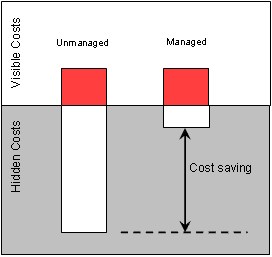
during the transition. Visible costs such as commissions and
taxes are usually easy to identify — much like the tip
of an iceberg. In contrast, hidden costs are harder to quantify
and the transition specialist is especially skilled in this
area. The main hidden costs are market impact, bid-ask spread
differences, liquidity, and opportunity costs (the cost of
prolonging the execution of the trade). Figure 1 illustrates
that a managed approach can substantially reduce hidden costs.
Figure 1: Visible and invisible costs
for managed and unmanaged transitions
Common transition management situations
Several current trends in the fund management
arena frequency prompt a fund to undertake a transition of
some kind. Below several are discussed, to clarify the place
of transition management.
a. Changing from defined benefit
to defined contribution fund
In order to remove long-term liabilities arising from pensioners’
claims to company profits, many corporates have changed their
pension funds from defined benefit to defined contribution
funds. This is a worldwide trend and we have seen this locally,
primarily with the corporate sector but also in the public
sector.
b. Implementing member choice in
pension funds
A further trend in the pension funds industry is the switch
of funds to a life stages model. These models cater for members
of different ages, which typically have varying degrees of
risk appetites. The implementation of such a scheme usually
implies a transition in the fund to accommodate the members’
choices.
c. Specialist mandates in pension
funds
A recent development has been the focus on specialist mandates.
Often, advisors would suggest a particular asset allocation
mix to a pension fund in order to best address the needs of
the fund. The best manager for a particular component of the
fund, say domestic equities, would be selected, usually after
a “beauty parade” of the competing asset managers.
The role of the transition manager would be to move the funds
between out-going and in-coming managers, transitioning the
funds towards the in-coming manager’s benchmark or house
view portfolio.
d. Changing asset managers in pension
funds and multi-managed funds
Prolonged poor performance of a fund manager usually results
in the funds being taken away and given to a manager with
a better performance record. This might be accompanied with
a change in benchmark for that portion of the fund. Although
there might be a fair amount of commonality between the fund
make-ups of the out-going and in-coming managers, usually
substantial amounts of switching between securities are required.
In order for the new manager to start his job on the best
foot, the make-up of the transferred securities should closely
reflect the new portfolio, or at least the new benchmark.
When a new manager has not been identified, the transition
manager can manage the funds in the interim. A temporary solution
could be an index/benchmark tracking fund or a peer group
tracking portfolio.
In the case of multi-managed funds, the change
of underlying fund managers or rebalancing of a multi-managed
portfolio can be more efficiently performed using a transition
manager.
e. Change in investment objectives, asset allocation
rebalance
Consultants are also called in when the investment objectives
of a fund need to change. Sometimes, their investment objectives
have never been properly formulated. Such a process usually
result in asset allocation changes, and the transition manager
would be able to facilitate the changes in the best manner.
Example: Changing fund managers
Perhaps the most common transition management
situation is that of changing fund managers. In the local
equity market, when moving assets from one equity manager
to the next, our research has shown that on average 43% of
the fund is common to the both initial and the target portfolio,
hence it can be transferred “in kind”. This means
that 57% of the fund is typically sold and a new 57% bought.
Clearly, with such a high turnover (114%), a professionally
executed transition is imperative.
The concepts of “in-kind” transfer
and turnover are illustrated in Figure 2 below:
Figure 2. Illustrative schematic of moving
from an initial to a target portfolio. The ”in-kind”
transfer of assets common to both portfolio is shown, and
also the sold and bought components.

Below we briefly review traditional strategies
(1 and 2 below) used during a manager change and we lead up
to far more innovative cost saving strategies (3 below):
1. Sell all the assets and give the
cash to the new manager
Selling off a portfolio and leaving the new manager
to buy a new portfolio is probably the worst strategy. Not
only would it incur the costs associated with a 200% turnover
but it would severely hamper the monitoring of risk (and possibly
the performance) of the new manager for a year or longer (because
of unwanted tracking error – see included box). The
direct and indirect trading costs would also be excessive,
rendering this the most expensive strategy.
2. Give the new manager the initial
fund
As fund managers are not specialist transition dealers in
assets, this option is likely to result in inefficient trading
and hence increased costs. Furthermore risk monitoring of
the fund manager will still be hampered because of unwanted
tracking error. Although there is some saving relative to
strategy 1 above - because assets common to both initial and
target portfolios can be retained, superior strategies are
discussed below.
3. Transition the initial fund to
the new benchmark using a Transition Management team
Transitioning the old portfolio to the mandated benchmark
– and handing the benchmark to the new fund manager
is a far superior strategy. It is superior from both a cost
saving viewpoint as well as from the viewpoint of monitoring
the active risk of the new manager. Furthermore far less overall
trading would be required as the benchmark is typically “close”
(low tracking error) to the new portfolio. The new fund manager
would thus need to do a relatively small quantity of initial
trading from the benchmark to the new portfolio. Thus handing
a new fund manager the mandated benchmark is an excellent
starting point.
A variation on this choice would be to transition
directly to the new fund. This would only be possible when
the new manager has communicated the new portfolio’s
composition to the transition manager.
Demystifying transition management
The actual steps taken in a transition management process
might be unknown territory to pension fund trustees. The role
of the transition manager in this regard is to lead the trustees
through this potentially complex process. The project management
role of the transition management team is also central. Figure
3 illustrates some of the important steps that forms part
of the transition management process.
Figure 3. Step-by-step guide to the transition
management process

Transition management stages:
• Pre-transition
In this phase, the transition management team makes all the
necessary preparations before the actual transition takes
place. This occurs in consultation with the trustees, asset
consultants and actuaries. As trustees are usually not very
familiar with the legal agreements, dealing with custodian
banks and security dealers, the transition manager will contact
all role players and facilitate the process from inception
to completion. A transition time schedule is drawn up and
all parties are made aware of their responsibilities.
• Pre-trade analysis
At this stage the transition management team would be informed
of the holdings of the initial portfolio and that of the envisaged
target. Optimal trade paths are established, leading to a
transition plan – usually using quantitative trading
models. Additionally cost savings are addressed in detail,
broken down into visible costs such as commissions and taxes
and hidden costs such as expected market impact and opportunity
costs.
• Implementation
In this phase, the actual transition takes place. Where there
is commonality between the original and target portfolios,
those securities that are common are transferred “in
kind”. The remaining securities are traded according
to the transition plan. At this stage, should cost saving
opportunities present themselves to the traders, the transition
path will be amended in a dynamic way to take advantage of
such opportunities.
• Optimisation
The optimisation of the trading path to take into account
the various aspects of cost and risk can improve the quality
of the trading results. Quantitative optimal liquidation strategies
are used to minimize trading costs. This is illustrated in
Fig. 4, where the expected tracking error (see box) is reduced
as soon as possible. The focus on tracking error as a risk
measure is important because lower tracking error implies
less risk of under performing benchmark. The differing liquidity
of the various assets to be traded is also taken into account
in the trading strategy.
Figure 4. Optimal reduction of tracking
error risk during the transition

• Settlement
The settlement of trades and cash movements should be coordinated
by the transition management team ensuring the accounting
of the trades with the custodian banks.
• Post trade analysis
Upon completion of the transition, a full post-trade analysis
should be prepared for the client, outlining the actual cost
savings of the transition and comparison to the estimated
pre-transition cost. Implementation shortfall is a common
benchmark used to evaluate the efficacy of the transition.
The cost savings derived from using a specialist
transition management team is likely to be invaluable to the
preservation of a plan’s assets during phases of shifts
in strategy of the plan.
Conclusion
An unmanaged transition can easily become a haphazard
affair where different parties are not properly communicating
and the important issues of risk control and minimization
of cost is ignored in the process. Instead, a disciplined,
integrated approach by a specialist Transition Management
team can add substantial value to a fund when there is a planned
shift in the assets managed. Trustees should be made aware
of the circumstances where a professional Transition Management
team should be used. Importantly the specialist risk management
and cost saving potential of professionally managed transitions
are likely to make them an important part of the pension fund
arena in South Africa in the future. The iceberg alert has
sounded and trustees would do well to consult experts when
embarking on any transition.


Dr Jaco Maritz and Prof Dave Bradfield
SPECIALISTS IN: risk management
• quantitative modeling •
dealing • derivatives engineering • administrative
and legal aspects of transitions
Contact: +27 21 657 8500 • www.cadiz.co.za
Dr Jaco Maritz • jaco.maritz@cadiz.co.za•
+27 21 657 8356
Prof Dave Bradfield • dave.bradfield@cadiz.co.za•
+27 21 657 8351
|


