Labour,
capital and productivity: Important growth determinants
By Christo Luüs
EcoQuant

  ebilitating
strikes have crippled many sectors of the South African economy
in recent months. One of the most severe was the strike by
more than a million government workers which lasted for more
than three weeks during August and September 2010. ebilitating
strikes have crippled many sectors of the South African economy
in recent months. One of the most severe was the strike by
more than a million government workers which lasted for more
than three weeks during August and September 2010.
Workers generally claimed to be dissatisfied
with the pay rise offered by government as well as with certain
allowances. However, some observers have argued that the political
motivation for the rather violent strike was as strong –
or maybe even stronger – than the financial reasons
cited by union members and bosses.
Although it is quite clear to see that motor
vehicle manufacturers, for example, stand to incur losses
due to striking workers – mainly because export orders
cannot be fulfilled – it is not all that clear what
the economic cost of a strike in the public sector could be.
Even though it is difficult to quantify the
short-term economic costs of prolonged strikes by government
workers, there is undoubtedly a direct link between economic
growth and the extent of capital utilistation, the number
of workers employed, and productivity levels.
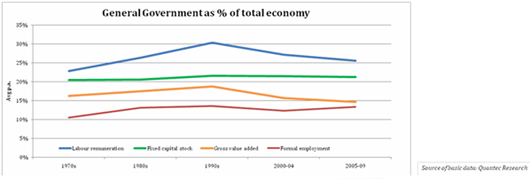
From the data and graphs it is clear that
the government has been a major job creator in the economy
over the past number of decades. By 2009, the general government
sector had increased its employment level by a total of 1,129
million employees since 1970, while the rest of the economy
had expanded its formal employment by only 1,786 million employees.
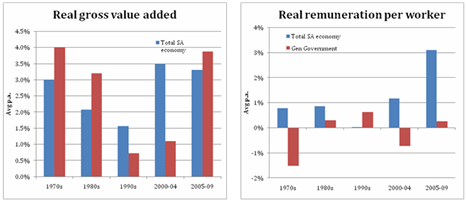
However, since the bulk of the job creation
in Government was apparently in the lower skilled categories,
real remuneration per worker had not risen to the same extent
as in the rest of the economy. Thus, over the past four years,
real remuneration per worker in the total economy had increased
by 3,1% p.a., which was higher than in any preceding period
since 1970 and also much higher than the figure of 0,3% p.a.
for General Government during 2005-2009. This real increase
occurred despite the fact that 2008 and 2009 saw one of the
most severe recessions since the Second World War.
The much higher levels of employment in government
relative to the private sector, nevertheless did very little
to lift productivity or indeed total production of general
government. The gross value added (GVA) contribution of General
Government to total GVA amounted to 16,2% during the 1970s,
but during 2005-2009, had shrank to only 14,7% of total GVA.
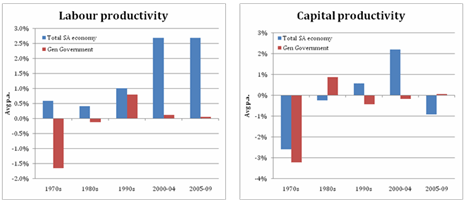
Labour productivity growth in the economy
had shown a more significant increase during the 2000s than
during the three preceding decades, but labour productivity
gains in General Government remained negligible during the
period 2000-2009.
Capital productivity growth in the total
economy amounted to 0,6% p.a. during the 1990s and increased
to 2,2% p.a. during 2000-2004, but again become negative to
the tune of -0,9% p.a. during the period 2005-2009. In contrast,
capital productivity growth of General Government has remained
at or below 0% since the 1990s.
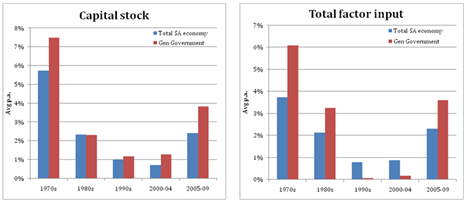
Consequently, multifactor productivity growth
(i.e. the growth in gross value added which cannot be explained
by the growth in total factor input) by General Government
has also been below that of the total economy for all periods
since 1970, showing that Government is generally speaking
not very good at creating growth through productivity enhancements.
South African taxpayers have indeed been
paying more and more but have been getting less and less from
government. Strikes are but another issue that will cause
the economy’s productivity levels to decline –
thus diminishing the country’s growth potential. This
vicious circle will be further reinforced by the tendency
to substitute more capital intensive production methods for
labour. This will on the one hand increase unemployment, but
on the other hand benefit production and service levels. After
all, machines cannot strike, deliberately damage property
or harm innocent people.

|


