Adapt or die
Why companies and investors can't ignore climate change
By Amy Underwood
Nedbank Capital

  ompanies and the investors who buy shares in them can no longer afford to ignore how the earth’s climate is changing. Not only is the scientific evidence mounting, but the tangible evidence is already making itself felt in rising temperatures and changing precipitation patterns. In response, regulation is changing, consumer preferences are changing and so too are investor attitudes. Companies and investors who ignore these changes do so at their own peril. ompanies and the investors who buy shares in them can no longer afford to ignore how the earth’s climate is changing. Not only is the scientific evidence mounting, but the tangible evidence is already making itself felt in rising temperatures and changing precipitation patterns. In response, regulation is changing, consumer preferences are changing and so too are investor attitudes. Companies and investors who ignore these changes do so at their own peril.
Where is the world going?
At the end of 2011, South Africa hosted the 17th session of the Conference of the Parties (“COP17”) to the United Nations Framework Convention on Climate Change (“UNFCCC”). While some progress was made, many were disappointed and expectations have shifted towards this year’s Rio + 20 meeting and COP18 for a more tangible manifestation of multilateral cooperation.
Despite the fragmented progress on the multilateral front, what remains indisputable is that the world cannot continue with “business as usual”. Business is already changing. Even where international talks have failed, regional efforts continue, country-level efforts continue, companies continue, civil society continues and individuals continue. The European Union (“EU”) hosts the world’s largest cap-and trade system and the EU has even extended its unilateral efforts to combat climate change by incorporating the airline industry into its emission trading system (“ETS”) as at January 2012.
Companies are already integrating the risks and opportunities of climate change into their businesses. For instance, out of Rolls Royce’s research and development spend of GBP923 million in 2010, two-thirds aimed at reducing the environmental impact of their products. They are also investing in law-carbon technologies, including tidal stream turbines, fuel cells and nuclear.
The importance of companies taking these kinds of risks and opportunities into account has also become extremely significant for global investors, as part of a broadening interest in Environmental, Social and Governance (“ESG”) issues. The United Nations Principles of Responsible Investment (“UN PRI”) has more than 1,000 signatories with approximately US$30 trillion in Assets under Management (“AUM”).
These principles encourage investors and those who act on their behalf to take into account ESG issues as part of the fulfillment of their fiduciary duty. As evidenced by the amount of assets controlled by the signatories, this thinking is becoming increasingly main-stream. Dolores Bamford, at Goldman Sachs Asset Management (“GSAM”) has said:
With GSAM Fundamental Equity, we believe that integrating ESG factors into our investment analysis can help identify industry-leading companies that utilise their resources in a sustainable manner to maintain enduring competitive advantage, grow and defend their global footprint, and drive economic returns throughout market cycles.
This is borne out by quantitative evidence. Goldman Sachs has a GS Sustain Focus List which identifies companies with the potential for sustainable corporate out-performance. From June 2007 to the end of 2010, the GS Sustain Focus List has outperformed the MSCI All Country World Index by 38.5% on an equally-weighted basis.
If one narrows the scope to the environmental, one still finds much evidence of both conviction and outperformance. As of the beginning of 2012, the Carbon Disclosure Project (“CDP”) represented 655 financial institutions with assets of US$78 trillion. The CDP has had a primary focus on carbon and climate change, but due to demand from their signatories is broadening their focus to include water.
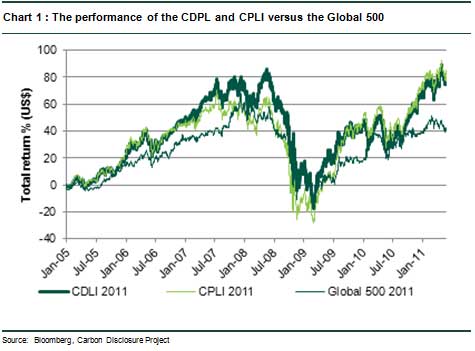
As part of their annual Global 500 reports, CDP has created a Carbon Disclosure Leadership Index (“CDLI”) and a Carbon Performance Leadership Index (“CPLI”) which is made up of the companies in the Global 500 which have scored the highest on disclosure and performance respectively. The disclosure scores assess the quality and completeness of company responses to the CDP questionnaires on how the company is handling climate change. The performance scores assess these responses with respect to how extensively companies are acting on the opportunities and risks presented by climate change. Between January 2005 and May 2011, these indices provided approximately double the average total return of the Global 500.
What this evidence bears out is the following:
- Companies are responding to climate change.
- Investors want companies to respond to climate change and are monitoring their responses.
- There is evidence that considering climate change in investment decisions already results in out-performance and a strong argument that companies that take hold of the opportunities presented by climate change will be better positioned for the future
So what is South Africa doing?
In December 2009, the South African government conditionally committed to reduce greenhouse gas emissions by 34% by 2020 and by 42% by 2025. While the conditions on which the commitments were made have not been met, the South African government has acknowledged the significance of South Africa’s emissions and begun to take unilateral action.
Even though only an automobile carbon tax has at this stage come into effect, many South African companies are positioning themselves to mitigate the risks and take advantage of the opportunities presented by climate change and broader environmental sustainability issues.
Last year in the CDP survey, South Africa had the fourth-highest response rate, at 70% of the Top 100 companies listed on the JSE. In 2011, the response rate rose to 83%. 81 Companies responded but two companies – Mondi and Investec - have two lines of equity in the top 100 so that equates to an 83% response rate. Also, even though the CDP Water Disclosure is still in its infancy, South African companies have already shown great initiative. Of 56 water-intensive companies approached for the first time in 2011 to participate, 26 responded and an additional five companies responded voluntarily. This demonstrates how widely the importance of environmental issues is appreciated by top South African companies.
One South African company which has deeply integrated these issues into their strategy is Woolworths through its “Good Business Journey” which targets transformation, social development, the environment and climate change. They have made very tangible efforts in increasing the resilience of their supply chain, reducing their energy usage and supporting food security. This has also been reflected in their market positioning in terms of appealing to consumers on the basis of offering organic and environmentally-friendly products.
In 2011, there were two important developments amongst South African investors in support of ESG principles. The latest amendment of Regulation 28 under the Pension Funds Act, 1956 states that:
Prudent investing should give appropriate consideration to any factor which may materially affect the sustainable long-term performance of a fund’s assets, including factors of an environmental, social and governance character. This concept applies across all assets and categories of assets and should promote the interests of a fund in a stable and transparent environment.
The South African investment community has also become the second in the world to voluntarily adopt a responsible investing code in the form of the Code for Responsible Investing in South Africa (“CRISA”). This Code adapts the UN PRI for the South African context and should assist pension fund trustees in their application of the amended Regulation 28.
| Incentives for Shaping a “Green Economy”
Both government and investors have a role to play in providing the South African economy with the correct set of incentives to develop into a “green economy”.
The province of Gauteng government defines the green economy as one in which business practices and infrastructure are configured
to deliver better returns on natural, human and economic capital investments, while at the same time reducing greenhouse gas emissions, extracting and using fewer natural resources, creating less waste and reducing social disparities.
The government is working on a series of initiatives around energy, greenhouse gas emission reduction and water usage to create an appropriate framework on incentives. Such incentives are exemplified in the REFIT programme which provides significant incentives for the development of renewable energy and the carbon tax initiative which should provide a carbon price for the South African economy. In addition, the government is also considering ways in which key industries for a “green economy” can be promoted at both a national and provincial level.
The framework which the government is putting in place will change the operating environment for existing companies. Having to incorporate a carbon price into their operations should incentivise companies to become more energy efficient at the very least and may also promote the incubation of low-carbon activities. It should also punish companies that fail to recognise the implications of the changing regulatory and tax environment.
However, for the South Africa economy, existing companies need to go further than simply responding to a carbon price. The physical environment is also going to change and companies will need to be resilient in order to weather the storms. Out of 10 sectors identified in the Carbon Disclosure Project’s Global 500 2011 Report, nine identified extreme weather events as a key risk to their sector.
In the 2009 Carbon Disclosure Project Report for South African companies, Anglo American identified a key risk to Anglo Platinum’s operations in Australia from more frequent flooding events. This demonstrates the importance of resilience. As extreme weather events increase in probability, the odds increase that such events will occur in successive years. If a company has not diversified its environmental exposure sufficiently to survive successive disruptions, this can have serious consequences for both the earnings and longevity of the company.
The Risks and Opportunities of Extreme Weather Events |
Sector |
Risks |
Opportunities |
Consumer Discretionary |
Extreme weather patterns may damage supply chains and manufacturing plants. |
|
Consumer Staples |
Increased risk of disruption to facilities, business operations and supply chain due to extreme weather patterns and natural disasters. |
|
Energy |
Increased frequency of extreme events: ice conditions in the North Sea, wave conditions and cyclones in tropical areas force companies to focus on climate change adaptation of new projects. |
|
Financials |
Insurance companies are concerned with extreme weather conditions as these could lead to a rise in insurance claims. |
|
Health Care |
Disruption of supply chains due to extreme weather. |
Changes in frequency of extreme weather conditions will present companies with opportunities that include the need for greater disease prevention and more patient treatments. |
Industrials |
Uncertainty around physical risks, such as extreme weather events and rising sea levels, could cause production factories to shut down. |
|
Information Technology |
Extreme weather conditions could result in an immediate financial impact if the availability of IT services is disrupted and supply chain and production processes are delayed. |
|
Telecoms |
Threat of extreme temperatures and changes in precipitation patterns could result in damaged equipment. |
Social disruptions resulting from extreme weather events may prevent populations from traveling and may result in greater use of telecommunication services. Such conditions would also generate opportunities to provide emergency response telecom solutions. |
Utilities |
Extreme weather conditions could affect operations (e.g. transmission cables are impacted by higher temperatures and greater electricity use during extreme heat. In addition, generating plants, which are usually in proximity of water, will be most susceptible to storm surges and rises in sea level) |
Droughts and water shortages may stimulate demand for water related industries... which, in turn, would stimulate demand for electricity |
| Source: CDP Global 500 Report 2011: Accelerating Low Carbon Growth |
|
Investors provide significant incentives for companies. Their treatment of companies’ stock and bond prices knock on to their cost of funding. If investors invest more money into unsustainable companies, then this will provide an incentive for these companies to expand. Then, when their resilience is tested, these companies will fail or falter, with potentially disastrous consequences for both companies and their investors. If instead, investors reward companies taking a sustainable approach, then they in turn will be rewarded with stronger earnings and share price performance.
This is why it is so important for investors to consider a company’s response to the changing environment. They need to reward companies who are responding by lowering their cost of funding and providing the pre-emptive signals for prepared companies to grow and unprepared companies to shrink. Should they fail to do so, the economy and investors will find themselves over-exposed to and excessively reliant on fragile companies. There will be no winners under such a scenario. |
Similarly to the quantitative evidence found internationally, the back-tested performance of the Nedbank Green Index suggests that environmentally responsible companies need not underperform the market and can, in fact, outperform. The Nedbank Green Index selects and weighs constituents based on environmental criteria and the only market-based adjustments to this are made on liquidity grounds.
Environmental criteria are measured based on disclosure and performance ratings from the CDP and on whether or not a company has a South African based Clean Development Mechanism (“CDM”) project. Because an index is rules-based, its development is subject to the strength of independent data sources. At present, the strongest sources are related to carbon and climate change and so the back-tested outperformance of the index provides support for the idea that responding to climate change has been to the benefit of companies and their investors.

Concluding Thoughts
Internationally and locally, the evidence is mounting that climate change and its impact on companies and investors cannot be ignored. Even if multilateral agreement is not reached, more and more governments are taking unilateral action to target emissions. As temperatures rise, precipitation patterns change and extreme weather events increase in frequency, countries, companies and investors who have failed to factor these changes into their strategies will face the consequences of their apathy.
Further Reading
Carbon Disclosure Project
The Carbon Disclosure Project is an independent not-for-profit organisation holding the largest database of primary corporate climate change information in the world. www.cdproject.net
United Nations Principles of Responsible Investment www.unpri.org
On changes in South Africa:
Bertrand, Adrian (2011) The Dawn of a New Era of Responsible Investment in SA in Collective Insights: the New World of Financial Regulation, Summer 2011
Lotz, M (2011) Towards an Integrated View of South African Energy Regulatory Developments, Paper in press
Pension Funds Act, 1956: Amendment of Regulation 28. National Treasury. Government Notice.
This report is not directed to, or intended for use by any person or entity who is a citizen or resident of or located in any locality, state, country or other jurisdiction where such distribution, publication, availability or use would be contrary to law or regulation or which would subject Nedbank Limited (“Nedbank”) or its subsidiaries or affiliates to any registration or licensing requirement within such jurisdiction.
This report has been issued or approved for issue by a member of Nedbank Limited and has been forwarded to you solely for information purposes and for your consideration. It should not be considered as an offer or solicitation of an offer to sell, buy or subscribe to any securities or any derivative instrument or any other rights pertaining thereto (“financial instruments”). This report is intended for use by professional and business investors only.
All trademarks, service marks and logos used in this report are trademarks or service marks or registered trademarks or service marks of Nedbank or its affiliates. This report may not be reproduced without the prior written consent of Nedbank or one of its affiliates. It may not be considered as advice, a recommendation or an offer to enter into or conclude any transactions.
Information and opinions presented in the report were obtained or derived from public sources that Nedbank believes are reliable but makes no representations as to their accuracy or completeness. Any opinions, forecasts or estimates herein constitute a judgment as at the date of this report. There can be no assurance that future results or events will be consistent with any such opinions, forecasts or estimates. Past performance should not be taken as an indication or guarantee of future performance and no representation or warranty, express or implied is made regarding future performance. The price, value of and income from any of the securities or financial instruments mentioned in this report can fall as well as rise. Certain transactions including those involving futures, options and other derivative instruments can give rise to substantial risk and are not suitable for all investors. Any opinions expressed in this report are subject to change without notice and may differ or be contrary to opinions expressed by other business areas or groups of Nedbank as a result of using different assumptions and criteria. Furthermore, Nedbank (including its directors, employees, representatives and agents) accepts no liability for any direct or indirect loss or damage incurred arising from the use of the material presented in this report, except as provided for in law.
Any prices or levels contained herein are preliminary and indicative only and do not represent bids or offers. These indications are provided solely for your information and consideration. The information contained in this report may include results of analyses from a quantitative model which represent potential future events that may or may not be realized, and is not a complete analysis of every material fact representing any product. Any estimates included herein constitute our judgment as of the date hereof and are subject to change without any notice. Nedbank and/or its affiliates may make a market in these instruments for our customers and for our own account. Accordingly, Nedbank may have a position in any such instrument at any time.
Directors, officers and/ or employees of Nedbank may, to the extent permitted by law, own or have a position in the financial instruments of any company or related company referred to herein, and may add to or dispose of any such position or may make a market or act as a principal in any transaction in such financial instruments. Directors of Nedbank may also be directors of companies mentioned in this report. Nedbank may from time to time provide or solicit investment banking, underwriting or other financial services to, for or from any company referred to herein. Nedbank may to the extent permitted by law, act upon or use information or opinions presented herein, or research or analysis on which they are based prior to the material being published.
The investments referred to may not be suitable for the specific investment objectives, financial situation or individual needs of recipients of this report and should not be relied upon in substitution for the exercise of independent judgment. It is recommended that you consult an independent investment advisor if you are in doubt about such investments or investment services.
|


