Impact of dividends withholding tax on local private investors
by Francois van Dyk
Senior Lecturer – Department of Finance, Risk Management and Banking
University of South Africa

  outh African Minister of Finance, Pravin Gordhan, recently announced(1) the new dividend withholding tax that is to be implemented from 1 April 2012. This article will briefly look at this new tax, primarily focusing on how this dividends tax will affect (local South African) private investors. Some background and also some further intricacies on the new dividends tax are, however, necessary. outh African Minister of Finance, Pravin Gordhan, recently announced(1) the new dividend withholding tax that is to be implemented from 1 April 2012. This article will briefly look at this new tax, primarily focusing on how this dividends tax will affect (local South African) private investors. Some background and also some further intricacies on the new dividends tax are, however, necessary.
The background to the new dividends tax
The dividends tax was originally scheduled or planned to be implemented in the latter half of 2010, but due to late drafting (and possibly re-drafting) of certain areas of the legislation (the dividend rules), amongst other things, this did not materialise.
The dividends tax will be levied on dividends paid (to SARS(2)) by South African resident companies or foreign companies listed on the Johannesburg Securities Exchange (JSE). The tax will be levied on the shareholder but must be withheld by either the company paying the dividend or a ‘regulatory intermediary’, on behalf of the shareholder.
The dividends tax replaces a system (secondary tax on companies(3)) that was unique to South Africa and only a handful of other countries. One particular reason why this new dividends tax was widely welcomed is due to the enormous difficulty other countries encounter, in understanding our companies tax – as the companies tax creates unwanted complexity in assessing South Africa as a potential investment destination. Thus, from this viewpoint, it makes sense that the new dividends tax is much more consistent, or in line, with South Africa’s major trading partners (as our trading partners do not use companies tax).
The mechanics and exemptions – short & sweet
The outgoing secondary tax on companies was a tax cost that was borne by the company declaring the dividend. The dividends tax, or dividend withholding tax, on the other hand is a tax cost carried by the shareholder (who is of course a beneficial owner of the dividend). Companies declaring a dividend will (in the absence of any exemptions) be required to withhold the dividends tax from the gross amount of the final dividend declared, and thus the shareholder will receive the net amount after the dividend withholding tax.

The declaring company (or regulatory intermediary) will be required to pay the tax to SARS by the last day of the month following the month of the dividend payment.
Dividends will be exempt from the dividend withholding tax if the beneficial owner is, inter alia, a:
- South African company,
- government or various quasi government institution,
- public benefit organisation,
- environmental rehabilitation trust,
- pension, provident or similar fund,
- medical scheme,
- shareholders of a micro business(4).
In terms of the entities named above, the onus will fall on the shareholder to submit a declaration that they are exempt from the dividend withholding tax, to the company that pays the dividends (or in some cases the shareholder’s broker, who will then make further arrangements).
Dividend tax rates around the globe & ‘Dividend washing’
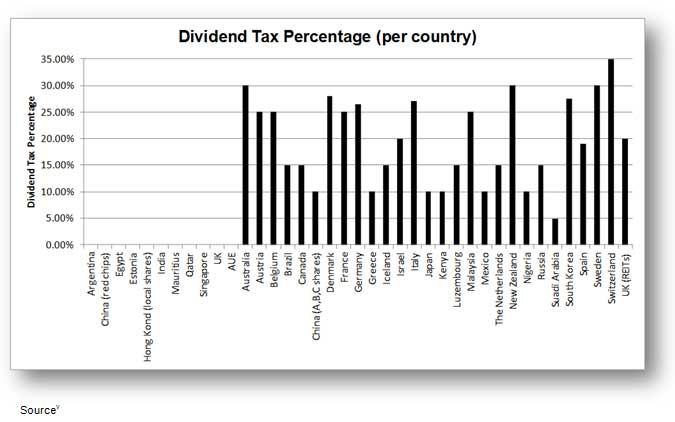
For the sake of informational completeness and intrigue, the graph below indicates the dividend tax (in percentage) levied by some other countries around the world.
(click on image for larger view)
Besides the actual number that constitutes the dividends tax, this particular tax practice opens the door for yet another frowned upon practice, which unfortunately is far too familiar in our country – fraud. Firstly, the opportunity will present itself for brokers (the regulatory intermediary) to totally clutter and confuse the designed process by some or other fault or omission and so further adding expenses and complications to the process, but the real ugly duckling is the opportunity of direct ‘fraud’ or ‘malpractice’ otherwise known as ‘dividend washing’ by corporates. A perfect example is the recent incident(5) where US regulators(6) filed against the Royal Bank of Canada (RBC) for trading hundreds of millions of dollars in illegal futures trades to secure ‘lucrative’ tax breaks – this all revolves around dividends taxes. In December 2011, reports surfaced claiming that some of London’s biggest banks are involved in a tax avoidance trading scheme to the value of around €600 million. It is thus not surprising that European tax authorities are starting to take an interest in the shadowy world of ‘dividend washing’.
Extension to ‘Principle of director’s liability’
The new dividend tax also further extends the principle of director’s liability as it considers certain executive directors of private companies (personally) liable for the tax in cases where the company fails to withhold and pay the tax. Although this principle is not novel per se, it does continue and further expand the somewhat alarming trend of eating into the concept of limited liability for companies.
The rate shock
The introduction of the dividends tax effective from April 2012, is to an extent old news, but investors did receive a shock when the Minister of Finance, Pravin Gordhan announced (in his budget speech) that the tax would come into effect at 15%. This is 50% higher than the previous secondary tax on companies of 10%.
If has always been understood that the net effect of the secondary companies tax and the dividends tax would be the same, thus the assumption and general expectation was that the dividends tax would be 10%. One could argue that this was the primary reason why the dividends tax was widely accepted (without any resistance).
In addition, the announcement of the rate change to the dividends tax came at the 11th hour. This cannot be very good news for impacted parties who have almost certainly begun preparing for the ‘switch’ from the old to the new system(7).
The reasoning behind this (late) rate change is equity considerations. It is also been mentioned that the (late) rate change is being used to mitigate the estimated net loss of around R2 billion from the ‘switch’ to the dividends tax, from the secondary companies tax.
The administrative burdens
Conceptually there is nothing complicated or sophisticated about the new dividends tax that is due to make its South African debut. It is, however, said that ‘the devil lies in the detail’ and that is the case here as well, as the complications arise when the exemptions come into play. In essence, detailed information will be required about shareholders, to a level that was, until now, not needed.
If the manner in which the investment industry is structured is taken into consideration, both obtaining and maintaining this information and accordingly, withholding the correct amount of tax, may not be such an easy task.
The (administrative) task is more complex and burdensome than anticipated due to the fact that the international financial system is built around financial intermediaries, and that in all of these intermediate structures there may be a number of layers between the issuer (of a security) and the beneficial owner. This effectively requires the information to be passed through multiple layers of financial intermediaries.
Furthermore, besides the administrative burdens involved in processing large amounts of paper, a more fundamental problem with any such requirement, and also with this specific requirement, is the fact that it is inconsistent with the intermediary’s business goal of protecting its proprietary customer information.
It is, however, clear that a comprehensive and effective process of information gathering is needed and that a clear, effective and efficient line of communication between the company, the regulated intermediary and the shareholder exists.
Local Investment Structure
Locally, the Central Securities Depository, commonly known under its abbreviated name of STRATE, regulates dematerialised listed investments. Linked to STRATE are six Central Securities Depository participants (CSD Participants), primarily consisting of the large banks and Computershare (which is the only non-banking participant). The CSD Participants are in turn linked to the next level of role players, brokers, who are the entities with direct contact with investors. The CSD, namely STRATE, compiles shareholder information from the CSD Participants, where after it is made available to companies via their appointed transfer secretaries. The figure below represents the primary role players and levels in the South African investment structure.
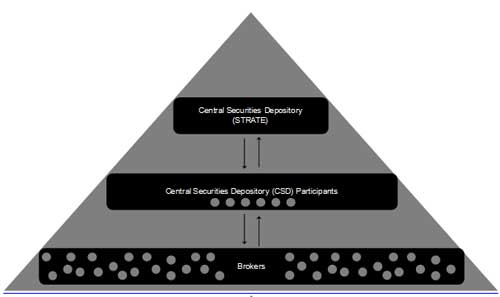
The distinctive chain of information flow is thus from the shareholder to the broker, to a CSD Participant, to STRATE. The payment of dividends from a listed company to its dematerialised shareholders would be the dividend payment to STRATE, who would in turn pay onwards to the CSD Participants, who would pay the broker, who would then pay on further down the chain to the shareholders. It should also be kept in mind that companies must run separate systems for certificated shares because these are not administered by STRATE, but by the appointed share transfer secretary (for the company).
In addition, both CSD Participants and brokers keep ‘nominee accounts’. Shares may thus be registered in the name of a nominee account, for example, “XYZ Nominees”, which would be the shareholders reflected on the companies’ sub-registers in STRATE and also the CSD Participants’ records. The nominee account (XYZ Nominees) will usually have shareholder details, but such information might not be sufficient for the purposes of administering the dividends tax.
This section highlighted that the investment structure as well as the administrative complexity involved in navigating the administration of the dividends tax within the somewhat complex local investment structure will be a challenge for regulators and tax authorities.
Effective rate of the dividends tax (on shareholders)
Due to the fact that dividends will from now on be declared exclusive of any dividends tax, shareholders will effectively be paying a slightly higher effective rate of tax (than under the secondary companies’ tax). A simplistic example might be useful to understand this a bit more clearly, so let’s assume a dividend of R1 million is declared.
Under the secondary companies’ tax (STC) this R1 million is considered to include the secondary tax on companies (STC). The calculation of the STC would be:

This would then leave R909 090,90 (R1 million – R90 909,09) as the net dividend for distribution to shareholders.
For the sake of this example let’s assume that under the new dividends tax system, the R1 million will attract a dividend tax of 10% (and not the actual 15%), which will thus equal a dividend tax of R100 000, and ultimately result in a net dividend of R900 000.
So, the eventual result is that shareholders receive R 9 090,90 less as dividends under the new dividends tax system compared to what they would have received under the (previous) secondary tax on companies system (if compared on similar bases). This discrepancy is due to dividends being exclusive of the dividends tax when declared, while the liability was inclusive of the STC – the reality remains that investors will be the ones that will feel this (on their returns).
Impact on (local) private investors
The impact and the shift
The biggest effect of the dividends tax will be that the investor’s total return will decrease, due to the 15% bite that the new dividends tax will take out of the declared dividend and thus out of the investors’ total return. The new dividends tax, however, creates a bit of a conundrum for investors; on the one hand rational investors will probably be pushed away from risky investments (for example equity) as the total (received(8)) return of these investments will now be lower due to the dividends tax. The other side of the coin leaves investors with the option of less-risky investments (for example, fixed income or money market investments) which will not be influenced by the dividends tax, although the question is whether these less-risky investments are still viable options for private investors (in market conditions similar to current).
A quick look around the investment landscape reveals that money-market funds currently offer returns in the range of 3.8% up to 5.36% per annum. While fixed-income funds offer the private investor an annual return in the region of 7.4% up to 8.6%. The question is, whether these less-risky returns are competitive enough if inflation is constantly lurking at around 6%, or maybe even a bit more.
Thus, on average the private investor will be faced with losing money (in real terms) when investing in money market funds, while only receiving a real return of around 2%(9) on average from a fixed-income fund.
An ‘informed’ and rational investor should, however, be aware that investment portfolios should consist of various asset classes, and at least a combination of equity (risky) and fixed-income (less-risky) investments or asset classes. So in a portfolio context the news won’t be as dire as portrayed above, but still the fact remains that any rational investor values higher returns more than lower returns - so why then will (rational) investors want to shift their portfolios towards less-risky asset classes when the real returns are not there.
Private investors might just be thinking about shifting away from risky investments (equity), for which their total return will now be less due to the dividends tax, and shifting towards less-risky investments (fixed-income). The reality is that this asset allocation shift might be easier said than done for a rational investor.
The reality is that investors are now between a rock and hard place – on the one side of the fence, investors’ total return will decrease (after they were the ones taking on the ‘added’ risk), while on the other side of the fence the combination of inflation and high-income returns are not what rational investors would call ‘perfect conditions’.
Ultimately, it remains to be seen if private investors will shift their investment portfolio a bit more towards less-risky asset classes due to the decreased total return that will end up in their pockets when holding risky asset classes like equity – the probability is there...
The contradiction: savings rate & dividends tax
Most South Africans are aware that South Africa has a very low savings rate (most commonly estimated as gross savings as a % of GDP) compared to peer countries. As an indication, Finance Minister Pravin Gordhan recently announced that South Africa had a gross savings rate of 16% of GDP in 2009, compared to China’s 52%, India’s 37% and Russia’s 22%. The Finance Minister added that the household savings rate declined by an average of 0.1% of GDP every year since 2001, and blamed this on “South Africans’ short-term outlook, a lack of transparency and cost-effective savings products, poor financial awareness and high unemployment”(10).
Government has (debatably) implemented some measures with the intention to reverse the decreasing trend in national savings. For example the adoption of the GEAR policy as the South African macroeconomic policy in 1996(11) and also the efforts of the National Treasury for making available RSA retail savings bonds which yield attractive rates of return over 2, 3, or 5-years(12) and which are easily accessible.
Besides the national economic advantages that accompany increased savings like (more sustainable) economic growth and reduced dependence on foreign capital, households or individuals (private investors) themselves garner the rewards of increased savings.
In current (modern) financial times most private investors use investment funds like collective investment schemes as saving vehicles, and for this reason the new dividends tax could also (indirectly) affect the savings rate (or at least the manner in which private investors save) – this leads to a contradiction. The government (rightly so) would like to see an increase in the savings rate and in particular the household savings rate, but the new dividends tax could possibly urge private investors (in this instance rather modern savers) to rethink where and how they would like to save.
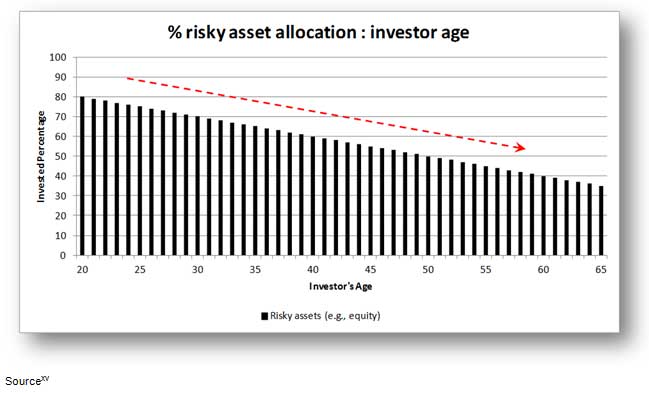
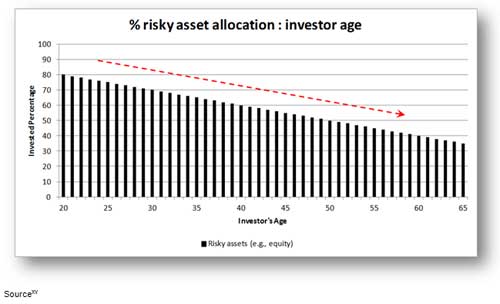
An example of the impact that the new dividends tax could possibly have lies in a ‘rule of thumb’ that is often used when evaluating investments and or savings, particularly investment or savings destined for retirement – this ‘rule of thumb’ states that the amount of risky investments (equity) in the investor’s investment portfolio should approximately equal 100 minus the age of the investor. Thus for a 20-year old investor approximately 80% (100% – 20%) of the investment portfolio should be allocated to risky investments (equity) and the remaining 20% (100% - 80%) should be allocated to less-risky investments (fixed-income). The investment portfolio for a 50-year old investor should have approximately 50% allocated to risky investments and 50% allocated to less-risky investments. The figure below highlights how the equity portfolio of an investment portfolio will decline over time according to this ‘rule of thumb’.
(Click on image for larger view)
This ‘rule of thumb’ is of course influenced by the principle of residual or remaining investment horizon - a young(er) investor would be able to absorb the additional risk (through larger exposure to risky assets like equity) over the long(er) investment horizon, i.e., the return volatility will be averaged out over time. An old(er) investor, according to the principle, has less time to absorb the additional volatility that is tied to risky investments over his/her short(er) investment horizon.
So based on this ‘rule of thumb’ which is driven by the remaining investment horizon of investors, rational investors will now either look for investments with increased risk and thus even larger returns to compensate for the bite lost to the new dividends tax, or simply shift towards more less-risky investments/asset classes. A number of questions, however, appear in both these cases; where will the investor find even more risky investments and will he or she be able to gain access to those investments, or will the investor simply have to move out of his or her preferred risk profile and thus tolerate more risk for the investment returns to ultimately still achieve the investment goals. The flip-side’s question is whether the investor would be satisfied with the lower return earned if he or she simply makes the shift towards less-risky asset classes, although this will also mean that the investor will have to move outside the preferred risk profile, but this time on the low (risk) side, which might also lead to investment goals being either altered or missed altogether.
In either case, the investor will have to choose on which side of the fence he or she would like to stand when the time comes to re-evaluate and adjust investment portfolios going forward into this new taxed environment. It also seems probable that the government’s objective of a higher savings rate, particularly from households, might not be aided by the new dividends tax as this new tax is arguable directly affecting (penalising) investors for taking additional investment risk in the pursuit of higher (real) returns, and all this in a somewhat difficult investment environment.
Conclusion
Like it or not, dividends tax is now a reality in South Africa and from an international trade and economic perspective it makes perfect sense. The downside, however, is that similar to many other aspects in South Africa, ‘end-costs’ are once again left to be absorbed by the public. Investors will have to re-evaluate their investment portfolios and current savings mechanisms in a rational and detailed manner while time will tell whether the regulators and authorities will make the designated dividends tax process a success.
(1) as part of the 2012 budget speech.
(2) SARS: South African Revenue Service
(3) Secondary Companies Tax (STC) was introduced in 1993 as an incentive to companies to reinvest their profits. It is levied on dividends declared by a South African tax resident company and is a charge on the company declaring the dividend as opposed to the shareholder. The only other countries were STC is still levied is India and Estonia.
(4) Note that only the first R200 000 of dividends paid during the particular year of assessment will be exempt.
(5) April 2012
(6) Commodity Futures Trading Commission (CFTC)
(7) Old system being the secondary companies tax (SCT) and the new system being the dividend withholding tax.
(8) With received is meant; in your pocket (return).
(9)Assumed with CPI at 6%.
(10)Finance Minister, Pravin Gordhan. Keynote address at the 10th anniversary of the South African Savings Institute and launch of Savings Month 2011 speech. (Available online: http://www.info.gov.za/speech/DynamicAction?pageid=461&sid=19955&tid=37235)
(11)which emphasised fiscal discipline characterised by a low ration of deficit by GDP as the anchor of fiscal policy
(12)RSA Retail Savings Bonds yield a 2-year fixed return of 7.25%, a 3-year fixed return of 7.50% and a 5-year fixed return of 8.00%. (Data obtained from https://secure.rsaretailbonds.gov.za/)
|