When is capital not capital? When it’s an own-credit-risk adjustment!
By Ingrid Goodspeed
Governor of the South African Institute of Financial Markets

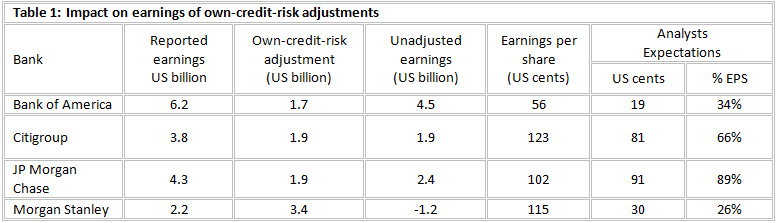
  n the third quarter of 2011 a number of international banking groups, Bank of America, Citigroup, JP Morgan Chase, Morgan Stanley reported positive earnings well in excess of analysts’ expectations, in spite of increasing credit spreads i.e., declining credit worthiness. This unexpected outcome was due to own-credit-risk adjustments(1) allowed in terms of U.S. accounting rule Statement 159. Statement 159 issued by the Financial Accounting Standards Board in February 2007 is titled the ``Fair Value Option for Financial Assets and Financial Liabilities". It allows firms to fair-value or mark-to-market(2) their liabilities as well as assets and to recognise associated unrealised gains and losses in earnings. Table 1 shows the impact. n the third quarter of 2011 a number of international banking groups, Bank of America, Citigroup, JP Morgan Chase, Morgan Stanley reported positive earnings well in excess of analysts’ expectations, in spite of increasing credit spreads i.e., declining credit worthiness. This unexpected outcome was due to own-credit-risk adjustments(1) allowed in terms of U.S. accounting rule Statement 159. Statement 159 issued by the Financial Accounting Standards Board in February 2007 is titled the ``Fair Value Option for Financial Assets and Financial Liabilities". It allows firms to fair-value or mark-to-market(2) their liabilities as well as assets and to recognise associated unrealised gains and losses in earnings. Table 1 shows the impact.
(click on image for larger view)
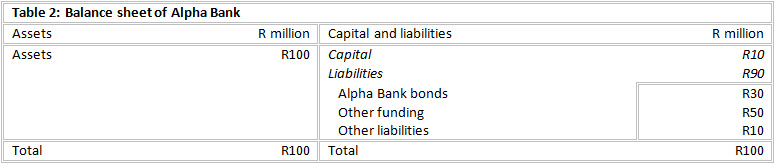
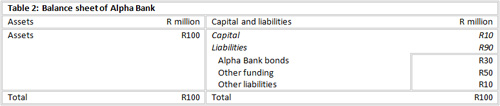
The following simple example attempts to show the impact of own-credit-risk adjustments on balance sheet. Suppose Alpha Bank has the following marked-to-market balance sheet.”
(click on image for larger view)
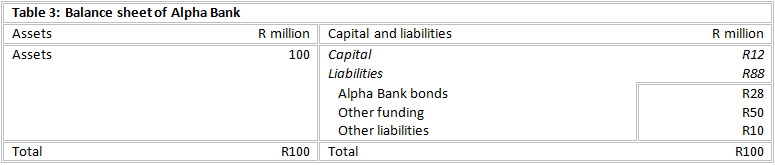
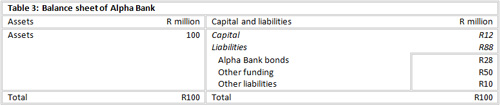
Assume the creditworthiness of Alpha Bank decreases. Its credit spreads widen and the price of its bonds will fall. If all other market prices remain unchanged, the revised marked-to-market balance sheet is shown in table 3.
(click on image for larger view)
Alpha Bank has an own-credit-risk adjustment of R2 million. This is reflected as a decrease in liabilities and an increase in capital through an unrealised gain in the income statement.
There are differing opinions as to the usefulness of own-credit-risk adjustments. According to Standard and Poor’s own-credit-risk adjustment “… calculations vary among companies, and we see little consistency in how financial institutions report them”. Furthermore it believes that “although the theoretical underpinning of reflecting own credit risks in fair value measures is sound from an accounting standpoint, the paradoxical result of recording gains due to weakening credit presents the most confusion in the marketplace. We remove the effects of gains and losses related to own-credit for analytical purposes according to our criteria.”
On the other hand the Chartered Financial Analyst (CFA) Institute supports the use of fair value to measure all assets and liabilities. It believes that the increase in shareholder value resulting from a credit downgrade is “not a fluke of fair value reporting but the result of differing contractual claims of shareholders and bondholders.” It explains that “…wealth is transferred from the existing bondholders, who have already committed to an interest rate and thus bear the risk of changes in interest rates to the shareholders. If bondholders had waited to purchase the obligations they may well have received a higher interest rate”.
The Basel Committee on Banking Supervision (“Basel Committee”) in its December 2010 consultative document Basel III: A global regulatory framework for more resilient banks and banking systems states in paragraph 75 that banks should “derecognise in the calculation of Common Equity Tier 1, all unrealised gains and losses that have resulted from changes in the fair value of liabilities that are due to changes in the bank’s own credit risk.” This rule ensures that an increase in credit risk of a bank does not lead to a reduction in the value of its liabilities, and thereby an increase in its common equity for capital adequacy purposes.
Of course, own-credit-risk adjustments can result in unrealised losses when banks’ creditworthiness improves. Bank of America reported that its first quarter 2012 earnings were impacted by the sharply changing value of its own debt. The improvement in Bank of America’s credit spreads resulted in a negative adjustment to earnings of USD4.8 billion. Citigroup, JP Morgan Chase and Morgan Stanley reported negative own-credit-risk adjustments, of respectively USD1.3 billion, USD0.9 billion and USD2.0 billion for the first quarter of 2012, resulting from the tightening of the banks’ credit spreads.
Since own-credit spreads will be an ongoing source of earnings volatility, should banks be considering hedging their own-credit risk? Any such hedge would involve going long the bank’s own credit, or credit closely correlated to its own. A bank could buy back its own debt, which will require a cash outflow, or sell credit default swap protection on its peers, which exposes it to basis risk. A further consideration: what would it say to depositors and investors if a bank actively hedges its own credit risk, will it send the wrong signal?
(1) Also known as debit (or debt) valuation adjustment (DVA). DVA is the amount added back to the mark-to-market value of debt and derivatives to account for the expected gain from a bank’s own credit default. It is related to credit value adjustment (CVA), which is the amount subtracted from the mark-to-market value of derivative positions to account for the expected loss due to counterparty defaults.
(2)Marking to market (or fair valuing) is the valuing of an asset or liability at the current market price of the asset or liability.
Bibliography
- Basel Committee on Bank Supervision. December 2010. Basel III: A global regulatory framework for more resilient banks and banking systems. www.bis.org.
- Basel Committee on Bank Supervision. December 2011. Application of own credit risk adjustments to derivatives. www.bis.org.
- CFA Institute, Centre for Financial Market Integrity. 2005. A Comprehensive Business Reporting Model. www.cfainstitute.org
- Standard and Poor’s. November 2011. Own-Credit Adjustments Helped Some Large U.S. Banks in the Third Quarter. www.standardandpoors.com
|