Creating
a Fixed Income Portfolio in Islamic Finance
By Ebrahim Patel
Bsc, BscHons, Mphil (Ethics), MIFM

 he
rise of the leveraged buyout industry and the turmoil in global
credit markets has catapulted debt and debt securities into
the financial limelight. In particular, it is the riskier
aspects of these two factors that have grabbed headlines.
In the leveraged buyout industry, the emergence of semi-equity
debt classes such as Pay in Kind (PIK) notes, mezzanine debt
and other hybrid debt-equity instruments have enabled the
buyout of companies by leveraging “lazy” balance
sheets above their inherent security levels – indeed
the creation of various classes of subordination has enabled
cash flow, and not the fire sale value of assets to be the
main determinant of debt capacity in a company. The forerunner
of these instruments, so-called “junk bonds” also
pushed the boundaries of fixed income investing when they
appeared roughly two decades ago. The current sub-prime mortgage
crisis has, amongst other factors, resulted from lowered lending
criteria thresholds. Of the many lessons that can be learned
from all of the aforementioned factors, is that there is generally
a high demand for debt, especially for high yield debt instruments,
with lending being extended even to risky counterparties with
no collateral. But why the high demand for debt? What are
the characteristics of debt that makes it such a desirable
asset class?
Firstly, the main characteristic of most
debt instruments, from coupon bearing bonds and mortgage bonds
to consumer debt, is that they return a fixed sum on a principle
amount and therefore have a fixed income payoff profile. The
return may vary according to ruling interest rates or pre-defined
indices, but on the whole, the timing and magnitude of the
resultant cash flows can be determined to within a certain
reasonable range.. The second very useful characteristic of
debt is that the principal amount is subject only to credit
risk, and not the risk associated with the purpose for which
it is employed. Debt may be secured by assets, which further
strengthens the probability of a lender regaining his capital
in the event of default, or it may be unsecured. If it is
unsecured, the borrower has still incurred a debt and has
a legal obligation to return the principal to the borrower,
even if it takes longer than anticipated. Thus, the fixed
payoff profile and capital protection offered makes debt a
very attractive asset class, particularly if used as part
of a portfolio strategy. To illustrate this, consider the
following example: A businessman wants to try his hand at
a new venture, but does not want to risk his capital. Very
simplistically, he can use the interest earned off his capital
as an equity contribution and take on debt for the remaining
amount, using the assets acquired by the debt as security.
He has thus used the fixed income market to provide him with
both equity and debt for his future venture, leaving his accumulated
capital intact and unencumbered. Fixed income cash flows can
also smooth out volatile equity cash flows, or provide a minimum
level of income while waiting for equity returns with long
lead times.
It is thus apparent that a strong fixed income
investment portfolio is crucial to a balanced, prudent and
capital protecting investment strategy. The use of interest
on debt is the primary means by which fixed income payoffs
are achieved. The question arises as to whether it is possible
to create a strong fixed income portfolio in an Islamic Finance
investment strategy, where the payment and receipt of interest
is strictly prohibited. It is indeed possible to construct
a robust fixed income portfolio in Islamic Finance using leasing
and rental agreements. This presents slightly different challenges
to the conventional set-up. Firstly, capital is embedded in
an asset that may appreciate or depreciate over time, meaning
that the capital recoverable at the end of the investment
horizon is not entirely certain, and that value may be created
or destroyed. Secondly, there are cash carrying costs associated
with the periodic cash flows, in that the asset must be maintained
and repaired if necessary – this will affect the modeling
of the cash flows and the pricing. Thirdly, in addition to
credit risk, there is the risk of destruction and accelerated
depreciation of the asset in question. Each of these factors
will be examined in detail below.
The depreciation value and fire sale value
of the asset being used to generate rental returns is of utmost
importance as it will determine the amount of capital to be
recouped at the end of the desired investment horizon. In
the case of a depreciating asset, adequate provision for depreciation
will have to be made in order to enable the full capital amount
outlaid to be recovered. Consider the example below:
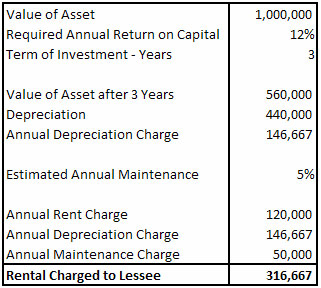
From the above example, we can see how to
incorporate depreciation and maintenance as well as required
investment return into pricing the fixed rental on an asset
that depreciates over time. The profitability of the lessor
depends on how accurately the depreciation rates and maintenance
charges can be estimated. Other factors to consider would
be administration and legal fees, bank charges, taxes, etc.
In the case of an appreciating asset, the above methodology
can be applied, except that there would not be a charge for
depreciation. The depreciation charge could be adapted to
represent a portion of the capital growth, and this could
be deducted from the required annual return in order to make
pricing more attractive, particularly in a competitive situation.
A portfolio of fixed income producing assets can be diversified
and risk adjusted by varying the types of assets held in the
portfolio. Adding depreciating assets with a short life but
higher yield to a portfolio comprising mostly of longer term
appreciating assets such as property will enhance the overall
yield of the portfolio. It is important to keep in mind, that
in Islamic Finance, the rights and obligations created between
lessor and lessee must be in accordance with Shariah law and
that there are no interest penalties that are applicable for
late payment. As a result, the credit analysis process is
of utmost importance when deciding on a lessee. In the event
of the asset being destroyed, the portfolio of assets must
have sufficient critical mass to be able to absorb such losses.
Should a loss be due to gross negligence or willful destruction
by the lessee, the lessee becomes responsible. In conclusion,
it should be noted that the formulation of a fixed income
portfolio in Islamic Finance is more involved than in the
conventional case, but the benefits of having a fixed income
portfolio surely makes the effort worth it.
|


