South
African Inflation and Rates
by
Nazmeera Moola and Gina Schoeman


  Global
food prices have soared
 booming global economy has driven up the prices of commodities
worldwide – even staples such as wheat, maize and soya
are at all-time highs. Global food prices have more than doubled
in the past three years. In March 2008, international food
prices were up 56.9% YoY. The run in global commodity prices
can be seen in the graph below; after lagging metals for years,
agricultural commodities have caught up rapidly (see figure
1).
Three powerful exogenous factors affecting
the supply and demand of food items across the world are at
play:
- Poor weather conditions in recent years;
- Growing income levels in countries such as China has led
to a stronger demand for meat;
- Surging oil prices have boosted the need for alternative
energy sources such as biofuels, which in turn consume large
amounts of corn, soya and sugar.
Despite all this, commodity prices, both
soft and hard, can’t keep increasing forever. At some
stage, global commodity price inflation will moderate, although
the risk is that the peak will come far later and be much
higher than expected

SA food inflation
is problematic…
After bottoming in March 2005 at a low of 3.6%YoY, consumer
price inflation in South Africa (as measured by CPIX) has
risen markedly. The latest reading, in February 2008, was
9.4% YoY. One of the main drivers of this upsurge has been
food inflation which has, since the start of 2006, increased
by an averaged of 8.7% YoY (14.6% YoY in February 2008) (see
figure 2). If the soaring food prices were excluded, CPIX
would have increased at a much slower average rate of 4.7%
YoY since 2006.

In South Africa, a strong driver of food
inflation in 2007 was the surge in the maize price thanks
to one of the worst droughts in twenty years. Luckily, good
rains in late-2007 helped stabilise domestic maize prices
and they have since steadied. For 2008, the culprit of food
inflation has so far been the domestic price of wheat. In
March 2008, spot international wheat prices were up 93% YoY
and, because South Africa is a net importer of wheat, this
puts pressure on staple food items such as the price of bread.
But, as mentioned, the saving grace for domestic food inflation
is the stabilisation of maize prices. Thanks to maize making
up 50% of livestock feed, meat and dairy products will benefit.
And because these two components have a higher weighting in
the overall CPIX basket than wheat-rich components like bread,
we expect food inflation to slow in the coming months, ending
the year in single-digits.
…but
overall inflation is also ticking up
Soft commodities are only a piece of the inflation puzzle.
Overall, consumer price inflation has been ticking up for
quite sometime. And despite food inflation contributing a
large part of this incessant increase, other factors are also
at play.
The price of petrol has increased 25.6% YoY on average over
the past 6 months. It is therefore no surprise that the transport
category increased by an average of 8.8% YoY for the same
period. In February 2008, thanks to a 17 cents/litre rise
in the petrol price, the growth in the transport category
hit double-digits at 13.2% YoY (see figure 2). Add to this
diesel prices rising by 46.8% YoY in March (and potential
shortages looming in the face of load-shedding) placed further
pressure on consumer pockets. If oil prices remain at elevated
levels, we can expect transport costs to remain problematic
and look for an average increase of 20% YoY for 2008.
Increases in food and transport prices have a disproportionately
negative impact on low income groups. These two categories
make up more than 50% of the low income consumption basket.
As a result, inflation for this group was up 11.9% YoY in
February, well above the average 9.4%YoY increase (see figure
3). Therefore, despite nominal wage increases averaging 9%
in 2007, an average inflation rate of 6.5% last year means
that real wage growth in the public sector slowed to 2.8%
YoY.
Ultimately, this means that inflation continues to eat away
at consumer’s pockets across income groups, leaving
overall spending slowing substantially. For 2008, we look
for consumer spending to average 3.0% YoY (down from an average
7.0% in 2007).

Interest rates
will remain high for a long time
Going forward, we expect that consumer inflation peaked in
March 2008 at around 9.5% YoY. Thereafter, the slowdown will
be very gradual, with the CPIX only dropping below the 6%
target ceiling towards the end of 2009. Part of the reason
for this gradual deceleration in inflation is that where food
inflation is set to ease, household electricity tariffs are
set to surge from mid-2008 onwards. Eskom has asked for a
60% increase to be implemented in June 2008, and for prices
to double by 2010.
If electricity prices rise by 30% in June, we expect this
to add about 1.3ppt to the annual CPIX average. At the same
time, oil prices may rise further, pushing up petrol prices.
Therefore, the upside risk to the inflation outlook for 2008
lies in electricity and transport costs. If electricity prices
increase by more than 30% and the petrol price rises further,
the year-on-year growth in CPIX would move into double-digits.
In an effort to combat higher consumer inflation, the SA
Reserve Bank has increased interest rates by 450 basis points
since mid-2006. Though inflation is being driven by exogenous
factors – mainly food and petrol, the SA Reserve Bank
maintains a strict inflation-targeting policy with a target
range of 3% - 6%. The behaviour of the Monetary Policy Committee
over the past two years suggests that until inflation peaks,
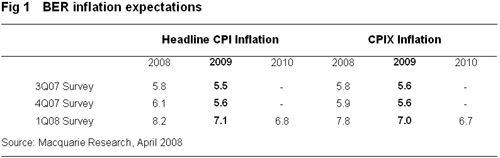
the Bank will remain on watch. Because both the BER 1Q08 survey
of inflation expectations (Figure 1) and the inflation forecast
of the SA Reserve Bank deteriorated significantly in the first
quarter of 2008, one last hike in April was not surprising.
And since inflation will take a long time to move back into
the target range, the chance of a cut in interest rates before
late 2009 looks slim.
With the US prepared to do whatever it takes
to avoid a deep economic recession, the Fed Funds rate looks
likely to decline further. This would expand the interest
rate differential between South Africa and the rest of the
world even more (Figure 5). Under normal circumstances, this
would cause the rand to strengthen, as carry trade inflows
are attracted by the higher yield in South Africa. However
two factors make the carry trade in South Africa less than
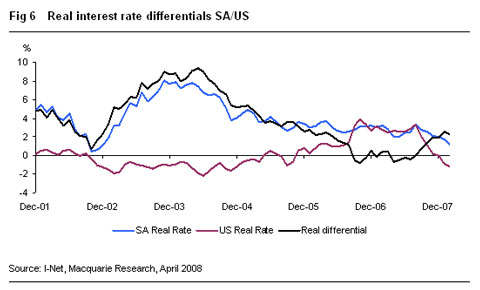
attractive. Firstly, the real interest rate differential is
far less attractive, as Figure 6 shows. Secondly, the uncertain
political climate, coupled with doubtful economic conditions
and electricity supply constraints all contribute to a negative
sentiment in South Africa which makes the rand less than attractive.

Two variables that could significantly change
the rate outlook are rand and oil prices. Our understanding
is that when the SA Reserve Bank updates its inflation forecasting
model, they tend to factor in something close to spot rand
and oil prices and then hold these constant for the duration
of the forecast horizon.
If the rand were to strengthen significantly over the next
few months, there could be a small chance of a rate cut later
this year. Similarly if oil prices were to fall sharply –
to say USD80/barrel, the inflation outlook would be markedly
improved, opening the door for a rate cut within the next
twelve months.
However, if the rand continues to weaken further or oil prices
go even higher, then a real risk of another rate hike exists.
Our base case is for the rand to stabilise at current levels
(ending the year at ZAR7.90/USD) and we have factored in quite
stable oil prices - though Macquarie’s official view
is for prices to fall a bit in the coming months. Added to
this we expect the prolonged rand weakness and slowdown in
consumer spending to result in an improvement in the current
account deficit. We look for an average rate of -5.9% as a
ratio of GDP for 2008. Therefore we see rates on hold for
the foreseeable future.
| Nazreem Moola |
Nazmeera.Moola@macquarie.com |
| Gina Schoeman |
Gina.Schoeman@macquarie.com |
| Tel +27 11 343 2200 |
|
Analyst Certification: The views expressed
in this research accurately reflect the personal views of
the analyst(s) about the subject securities or issuers and
no part of the compensation of the analyst(s) was, is, or
will be directly or indirectly related to the inclusion
of specific recommendations or views in this research. The
analyst principally responsible for the preparation of this
research receives compensation based on overall revenues
of Macquarie Group Ltd ABN 94 122 169 279 (AFSL No. 318062
)('Macquarie') and its related entities ('the Macquarie
group') and has taken reasonable care to achieve and maintain
independence and objectivity in making any recommendations.
Disclaimers: Nothing in this
research shall be construed as a solicitation to buy or sell
any security or product, or to engage in or refrain from engaging
in any transaction. In preparing this research, we did not
take into account the investment objectives, financial situation
and particular needs of the reader. Before making an investment
decision on the basis of this research, the reader needs to
consider, with or without the assistance of an adviser, whether
the advice is appropriate in light of their particular investment
needs, objectives and financial circumstances. There are risks
involved in securities trading. The price of securities can
and does fluctuate, and an individual security may even become
valueless. This research is based on information obtained
from sources believed to be reliable but we do not make any
representation or warranty that it is accurate, complete or
up to date.
We accept no obligation to correct or update the information
or opinions in it. Opinions expressed are subject to change
without notice. No member of the Macquarie group accepts any
liability whatsoever for any direct, indirect, consequential
or other loss arising from any use of this research and/or
further communication in relation to this research.
|


