Green
shoots in an arid landscape
by Gina Schoeman


  ismal economic indicators confirm that the global financial
crisis has set an especially dreary scene for global economic
activity in 2009. With trade figures all but keeling over,
confidence in the doldrums and credit still firmly under
strain, there seem to be few catalysts to rehydrate global
growth in the coming quarters.
But there are some green shoots pushing through the concrete.
Several factors cut through the gloom and while sizeable
uncertainties remain, these could give reason to think that
the recent freefall in global economic activity should reduce
in intensity in the coming months.
Front-loaded
weakness...
- Firstly, there is an argument that much of the weakness
was front-loaded. This is exemplified in the pattern of
inventories in the current recession. The Macquarie Inventory
Index shows destocking surged sharply in 4Q08, before
bouncing along at very weak levels in the first weeks
of this year. This suggests that much of the inventory
adjustment and impact on production in the current recession
could have been in late 2008 to early 2009.

-
While the inventory component of the
PMI manufacturing surveys for the major developed economies
has continued to push deeper into contractionary territory
in the first two months of this year, the rate of deterioration
has nonetheless slowed. So though the level indicates
that the reduction in inventories could continue to subtract
from growth in 1H09, signs that this indicator is starting
to stabilise, albeit at an extremely poor level, represents
an important bright spot. Stability in inventories, if
sustained, would lay the groundwork for firmer manufacturing
production and business investment. And furthermore, given
that inventories seem to have become increasingly pro-cyclical
in recent decades in the major manufacturing economies
such as the US and Germany, this could form the basis
for a reasonably firm recovery.
-
Business surveys for the major developing
economies, for example for China, also offer support for
this positive second derivative. Current levels of the
PMI surveys confirm manufacturing activity is still contracting
sharply, however the rate of contraction in these indicators
also seems to be getting slower. This signals an important
inflection point for GDP growth, if sustained,
-
Some data points are emerging to support
the shift in business sentiment. For example, after several
consecutive months of decline, US retail sales rose in
January, and Euro area retail sales were flat on the month
in December. Chinese credit growth also quickened in January,
and UK house prices rose slightly in the month after nearly
a year of back-to-back falls.
Households show some signs
of life
-
The other emerging sign of life to
watch for is household consumption. Plunging consumer
price inflation globally in recent months has bolstered
consumers’ real disposable income, representing
an important offset to sliding employment. The very low
interest rate environment also helps, reducing households’
debt servicing burdens. As a result, rising real income
can be expected to start supporting real consumption spending,
once consumer confidence stops falling. With policy stimulus
in place, an improvement can be expected as early as 1H09,
particularly if the pace of job cuts starts stabilising.

-
This positive deflation effect should
work to foster a recovery in production. Stronger consumption
spending from 1H09 would expedite the drawdown in firms’
stocks, and induce an improvement in their output. And
eventually, this could start to support an inventory build
in 2H09, which would itself be positive for GDP growth.
Significantly, there is a disparity between companies’
assessments of demand and production in the major monthly
business surveys, with demand readings plunging much sharper
than production expectations. This means that should real
income gains hold up consumption, and prevent as sharp
a drop in demand as companies anticipate, there could
be an important turning point.
... Back-loaded policy support
-
Above any other green shoots, aggressive
policy support has a particularly long stem. Despite the
overwhelming weakness in global economic activity right
now, stimulus offers prospect for recovery. This is the
crucial factor underpinning the subtle yet positive shifts
in inventories and household consumption, as the bolder
the response, the greater the chances positive momentum
will properly take hold.
-
The US, and also the UK, offer important
examples that policy does work. Both economies are pushing
through forceful monetary and fiscal expansion, and have
also made attempt at comprehensive reform of the banking
system. Against these efforts, there have been some important
improvements. For example, US personal consumption growth
actually rose in January. Yields on US corporate bonds
have edged lower, and issuance has improved appreciably.
Furthermore, the Federal Reserve’s January Senior
Loan Officer Survey shows that fewer US banks tightened
lending standards over the past few months compared to
the October survey, which suggests that the squeeze on
credit, may have reached a peak.
-
In the UK, household consumption has
also proven remarkably resilient to rising unemployment,
falling wealth, and a housing shock. With the Bank of
England drawing closer to putting its own quantitative
easing into action, and the second round of the bank rescue
package underway, lending should start to track a similar
trend to the US. Notably, mortgage approvals have recently
steadied, albeit at an extremely low level, and with nationalised
lender Northern Rock ready to offer an additional £14
billion in mortgage funding under the package, this should
curb the rate deterioration in the housing market.
-
Massive fiscal stimulus, monetary
easing and a scheme to fix the financial system are an
undoubtedly potent combination. It is true that fiscal
support and financial rescue measures have proven less
timely than hoped in the US, and UK policymakers were
tardy in their response to the crisis, suggesting a weak
near-term outlook. However, this three-pronged policy
approach should inevitably gain traction over economic
activity, pointing to the prospect of recovery from late
2009. The approach also seems set to become increasingly
widespread in the coming quarters, with interest rates
dropping closer and closer to the floor and the capacity
of conventional policy exhausted. For example, Canada
is now reportedly considering quantitative easing.
-
Currency is also an important mechanism
to support economic recovery. Japan offers an example
of its powerful impact, with industrial production and
capital expenditure collapsing. Plunging export demand
is the driving force, and highlights the pass-the-parcel
effect of currency shifts in transmitting what was originally
a US-centric downturn. With the Yen so strong, more production
cuts undoubtedly lie ahead, for example as automakers
struggle to work through sizeable inventories. This presents
a hefty barrier to the economy’s external adjustment,
and begs structural adjustment. On the flipside, the easing
in the Renminbi has been an important means to prop up
slumping external demand for China. Indeed, the Chinese
manufacturing PMI steadied in February, and industrial
production growth improved slightly in December. Combined
with policy help to stimulate domestic demand, the power
of currency to drive recovery cannot be discounted.
United States
-
The best that can be said about the
US economy is that the rate of deterioration seems to
have slowed. This is definitely not true in some sectors,
especially construction. But the stabilisation of manufacturing
surveys since late 2008, including the ISM survey, is
a potential green shoot. One factor that may be starting
to put a floor under US manufacturing, albeit at an extremely
low level, is a slight improvement in household demand.
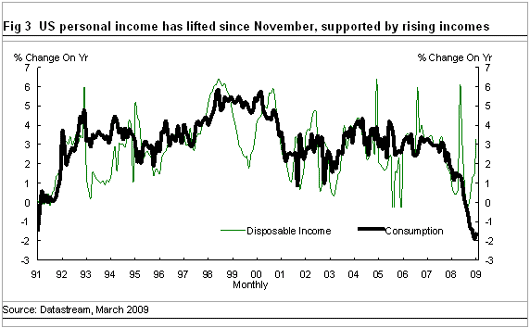
Personal consumption spending has lifted since last November.
The January level of real spending was actually higher
than the 4Q average, suggesting that the impact on GDP
growth from the household sector may not be quite as severe
in the current quarter. Lower auto sales in February were
a reminder that there are still some significant risks.
-
But perhaps the strong rise in real
disposable income driven by lower oil prices is starting
to exert a positive influence on consumer demand. Consumption
growth has been well below income growth for some time.
Plunging confidence is the main reason for this divergence
and the lack of confidence could mean that the gap does
not close immediately. Nevertheless, if disposable income
can hold these gains it is probable that there will be
at least a mild consumption response.
-
While the abysmal labour market will
remain a drag on household cashflow, it is likely that
this will be offset by the tax cuts that will commence
in April and disposable income should get another boost.
With the Fed’s new TALF program in place from late
March, there will be some additional support for auto
sales. The auto sector will be crucial. Even a slight
rise in auto demand would have a marked impact on the
economy because of the extraordinarily low level of domestic
motor vehicle production in early 2009. An inventory-related
swing in production would then give US manufacturing a
welcome boost in the second half of 2009. But a lot will
depend on US consumer confidence.
Europe
-
Several European business and consumer
sentiment surveys showed some signs of stability at the
beginning of this year, offering very recent suggestion
that the rapid deterioration in Euro area economic activity
in 4Q may have eased in early 2009. Indeed, the pace of
the decline in the Euro area PMI surveys, and the European
Commission’s economic sentiment indicators, has
slowed from the precipitous rates of late 2008.
-
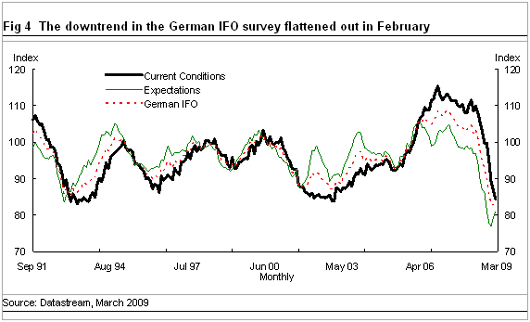
Central to these glimmers of light
is the German IFO survey. Significantly, the survey’s
expectations component rose for the second consecutive
month in February. This sub-index is a reasonable leading
indicator, and its uptick in encouraging. The headline
IFO index was little-changed at 82.6, down from 83.0,
with current conditions to continuing to worsen, but the
downtrend has clearly levelled off since mid-4Q. So while
it does not point to the end of the current downturn,
its stabilisation suggests a more disastrous outcome than
the early 1990s German recession is not looming.
-
Outside of the survey, the hard data
continue to highlight the downside risks to activity in
the coming quarters. For example, factory orders continue
to contract sharply and unemployment is rising at an increasing
pace. And with uncertainty continuing to grip households
and firms, expectations could quickly regress if the financial
crisis were to intensify. With Eastern Europe’s
problems on the Euro area’s doorstep, this is an
important factor to keep in mind.
-
As a result, the lag between positive
leading indicators and current conditions could be particularly
long, with fiscal and monetary support expected to take
several months yet to filter through to real activity.
However, stabilisation is an important precondition for
outright improvement.
Emerging Europe
-
It is simply too early to be looking
for green-shoots in emerging Europe, with many economies
still in free-fall. Demand for key export industries has
been decimated, whilst dependence on foreign financing,
coupled with large external imbalances, is proving destabilising.
Private capital inflows are expected to fall a massive
88% during 2009 and an estimated US$200bn is required
to support the banking system. This is on top of the support
packages the IMF has already announced for Hungary, Latvia,
Serbia and the Ukraine. Yet regional policy makers have
little room to move. Concerns over large currency depreciations
are keeping domestic interest rate declines in check,
while high government debt levels are constraining fiscal
measures. Rising unemployment levels have led to the incidence
of political instability and undermined support for market-oriented
policies in some countries.
-
Perhaps the best that can be said
for emerging Europe is that it is heterogeneous. Although
the entire region has and will continue to be hit hard,
some economies are showing signs of being more resilient
than others. Slovakia and Slovenia are already in the
Eurozone, and hence have not been hit by rising local-currency
debt levels. Poland, meanwhile, is much less reliant on
export demand than elsewhere in emerging Europe, and these
3 economies are still expected to maintain slightly positive
growth rates in 2009, compared to a 6.3% contraction in
the Baltic states. These distinctions, however, are more
a matter of the severity of the recession, rather than
if there is one. The best-outcome will be recovery in
late 2009, while weakness in the worst-affected countries
of the Baltic states, the Ukraine, and Hungary, could
linger well into 2010, lagging any global recovery.

Japan
-
The economic contraction in 4Q08 was
extreme and it looks as though 1Q09 will be about as bad,
with an export collapse driving down industrial production.
In turn, this has triggered a rapid reduction of temporary
workers in manufacturing which has led to national angst
over job security and a rise in the household savings
rate.
-
There are signs that Japan might be
close to the point of maximum pain from two perspectives.
First, production cuts over the past six months have been
extreme, with the aim of reducing excess inventories.
It looks like this process will have largely run its course
by the end of 1Q09, when the level of production will
bounce to a level in line with underlying demand. This
still implies low capacity utilisation rates and poor
corporate profitability, but not as depressed as in 1Q09.
As shown in Figure 7, the automobile sector is a good
example, with output running far below sales, and the
individual companies are reporting inventory reduction.
-
Second, there are signs that policy
neglect has reached an inflection point, with the survival
instincts of a government in an election year pushing
them towards more aggressive fiscal stimulus. The political
weakness of the government means there will be some doubts
over implementation, but at least the inaction of recent
months is fading. We do not expect a radical approach
from the BOJ, which seems surprisingly tolerant of the
prospect of another lengthy period of deflation.

Asia ex. Japan
-
Asia finds its economies at a crossroads
in the current downturn. For the region’s export
driven growth model, there are signs of hope in US and
EU retail sales as 2009 starts. Stabilisation in global
consumer demand is critical in containing the aggressive
corporate sector adjustment of the past few months as
reflected in job shedding, destocking and reductions in
capital spending. Unfortunately, from our vantage point,
the recovery in US and EU consumption is unlikely to gather
momentum given the sharp drop in the net wealth of households,
rising savings rates and insufficient fiscal responses
to date.
-
Our ‘Asia must save Asia’
mantra of the past several months is even more critical
given the uncertainty about the sustainability of global
demand. The good news is that Asian policymakers are quickly
reassessing the potential severity of the current global
recession and its impact on the region’s economic
prospects. Hong Kong and Malaysia have announced that
they will reinforce previous fiscal stimulus packages
to boost growth. Singapore’s Mentor Minister Lee
suggested that economic output could fall by 10% this
year.
-
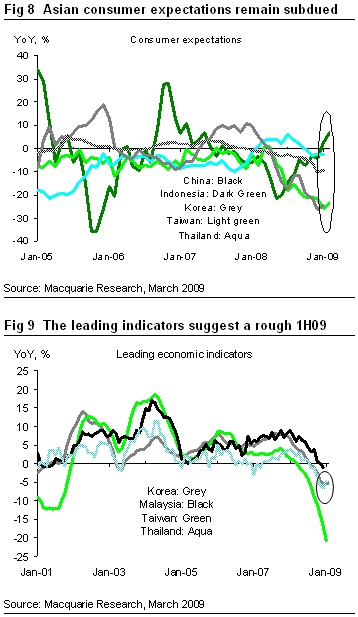
Further policy ease cannot come too
soon. While the data points outside of China remain weak,
the leading indicators of economic growth and consumer
expectations have stabilised, and in some cases such as
Indonesia, bounced (Figures 8 and 9). We continue to expect
interest rate cuts to get better traction in ASEAN ex
Singapore and India, where the cost of capital, and its
availability, are of more an issue for their supply constrained
economies than in North Asia where the lack of external
demand is the issue. Moreover, household debt levels are
already very high and capital spending tracks the global
trade cycle.
-
Asia’s strong macro balance
sheet, which we have highlighted in previous pieces (ample
foreign exchange reserves and low net debt (public and
private) levels among others), provide policy makers the
flexibility to further reduce interest rates and boost
fiscal spending. But more fundamental changes will be
needed to rebalance Asia’s growth drivers toward
domestic sources of growth. This will involve aggressive
infrastructure spending, the adjustment of tax structures
and the deepening of social safety nets. Given the absence
of such adjustments, Asia’s potential growth rates
will shift sharply downward given what we expect will
be protracted slowdown in the OECD.
China
-
There are signs of two divergent trends
in China’s economy. Exports have finally and spectacularly
succumbed to the global crisis, falling almost 30%YoY
in February. This result is even worse than it looks,
because Chinese New Year fell in February 2008, meaning
sales last month should have benefited from an increase
in the number of working days. Coincident indicators meanwhile
suggest a material recovery in domestic demand, with the
PMI reaching 49 in February, up strongly from 38.8 in
November last year, and just shy of the 50 needed to show
expansion.
-
In the short term, the economy is
likely to lose momentum. With a high base in March last
year, China’s export performance is likely to be
even worse this month than February’s shocking figure.
As for the domestic recovery, with few of the hyped infrastructure
projects yet underway and real estate construction still
contracting, there hasn’t been much sign of final
demand. Instead, it looks like a restocking cycle that
has already come to an end, with steel prices coming off
again in recent weeks.
-
The restocking cycle was only made
possible by a big rise in working capital, as the banks
stepped up financial support for the economy. Indeed,
bank lending has been as strong as exports have been weak,
with credit growth likely now near 25%YoY, the fastest
since the 1990s. By stabilising the domestic economy this
surge in bank lending is leading to some mobilisation
of savings, suggested by rising liquidity preference,
China having one of the few global stock markets to have
risen this year, and a firming of property transactions.
-
Certainly, the export numbers are worse
than we expected, and mean downwards risk for our 6.4%
1Q09 GDP forecast. Still, we already had a negative 2ppt
contribution to GDP from net exports built into our numbers
for 2009 as a whole. At the same time, the monetary trends
are more powerful latter than we had forecast, which should
lend more support to the recovery we were looking for
in 2H09.
South Africa
-
Economic growth in South Africa peaked
in 2006 at an average rate of 5.3% YoY, and has been slowing
ever since (averaging 5.1% YoY in 2007, 3.0% YoY in 2008).
In this way, South Africa looks relatively better-positioned
than other economies facing the sharp deterioration in
economic growth levels given the global financial crisis.
Thanks to a steady slowdown in growth over the past 18
months, the adjustment to global recessionary conditions
is more gradual for South Africa’s economy.
-
Still, official data releases in February
have confirmed that the South African economy will not
escape unscathed. First up, manufacturing production for
December contracted massively, leading to a worse-than-expected
contraction in GDP growth of 1.4% QoQ in 4Q08 . Even though
this left growth averaging a relatively healthy 3.0% YoY
for the year, prospects for 2009 growth worsened and we
now expect growth to contract by around 0.4% YoY in 2009.
Thirdly, credit growth is slowing rapidly after reaching
highs of 22.0% YoY in 2008; this confirms our suspicion
that SA banks are aggressively pulling back on lending.
And lastly, export growth is in trouble after falling
off a cliff in January (contracting by a massive 23% MoM).Even
with a pick up in February, exports will suffer in 2009
which leaves the outlook for domestic manufacturing production
very dismal.

-
Nonetheless, there are still some
bright spots for the local economy. Firstly, the government
is doing its share, expanding the 2009/10 budget deficit
to 4% of GDP from virtually flat levels. Secondly, after
much speculation, the SA Reserve Bank stepped in with
a more frequent MPC meeting schedule and are expected
to cut the repo rate by 400bps overall for 2009. Taken
together, monetary and fiscal policy is most likely set
to become more stimulatory than ever before and this will
filter through strongly into the real economy given that
the SA banking sector is relatively sound.
Australia
-
The Australian economy shrank by 0.5%
in 4Q08, even though final demand spending rose in the
quarter and by 2.6%YoY. In effect, businesses slashed
production in anticipation of much weaker spending in
2009, with the result that inventories nosedived in 4Q.
The question now is whether the current pessimism of the
business community will be realised, or whether spending
might prove to be surprisingly resilient.
-
To be sure, there are some sectors
of the economy where it seems inevitable that demand will
fall sharply. While business investment rose by 0.7% in
4Q08, we suspect that this was the last hurrah for investment,
which we expect will fall sharply in 2009. Consistent
with that, we think the demand for manufactured output
– and exports generally – will remain weak
for the next 18 months.
-
But while these are likely to be the
weakest components of the economy, there are some sectors
which have been improving – rather than weakening
– in recent months. Retail spending is one example.
This has grown in 6 of the last 7 months, with growth
improving from less than 2%YoY in September 2008, up to
6%YoY in January 2009. Although this is primarily due
to the Government’s fiscal injection in December
2008, with another larger stimulus coming in the March/April
period it does seem likely that retail spending will be
significantly stronger in 1H09 than it was in the same
period a year earlier.
-
Of course, it could be argued that
while the fiscal stimulus packages are providing a temporary
boost to spending, retail trade could still collapse once
the injections cease. However, there is another encouraging
sign that is likely to prove more enduring: an improvement
in the housing market. As shown in the chart below, home
loan approvals have risen by more than 20% since September
2008. Importantly, this reflects increased activity by
first-home buyers. Because first-home buyers represent
new entrants into the housing market, they increase net
demand, thereby adding some tension to house prices.

-
Evidence of this improved sentiment
is also reflected in other data, such as increased foot
traffic at building display home centres, and rising auction
clearance rates, which have risen from 45% in mid 2008
to 70% in early 2009. If this momentum is sustained, then
it is likely to result in stronger housing construction
in 2H09, which will be vital to supporting current employment
levels. At the very least, the persistent rise in home
lending since September 2008 – and the increased
activity by first-home buyers both in terms of the rising
number and rising average loan value – highlights
that the Australian housing market is not experiencing
the same sort of credit crunch which is undermining the
housing markets of some other developed markets.
New Zealand
- While there are no signs of the green shoots of recovery
in New Zealand, it doesn’t appear that New Zealand
has suffered as badly as elsewhere. Though the economy
has been in recession for some time, it doesn’t
appear to be as severe as the contractions seen in the
US, Europe or Japan. The labour market has also been surprisingly
robust thus far, with the unemployment rate rising 1ppt
off an extremely low base of 3½%. And despite the
huge downturn in housing market activity, the falls in
house prices and the impact on the banks have thus far
been tame compared to that seen offshore.
- Policy also has moved quickly and is already effective
in muting the impact of the current downturn. The large
fall in the currency has mitigated the impact of the crash
in commodity prices, with nominal exports rising 3%YoY
in January. Interest rates have also fallen a long way,
providing an important boost to household incomes, with
the transmission of monetary policy not impaired by a
broken financial system.
- Policy also has further scope to move. The cash rate
is still relatively high, while the government has very
low net debts. So while the green shoots of recovery are
not yet visible, the seeds of recovery have been sown,
with the economy likely to start growing again in 2H09.
|


